
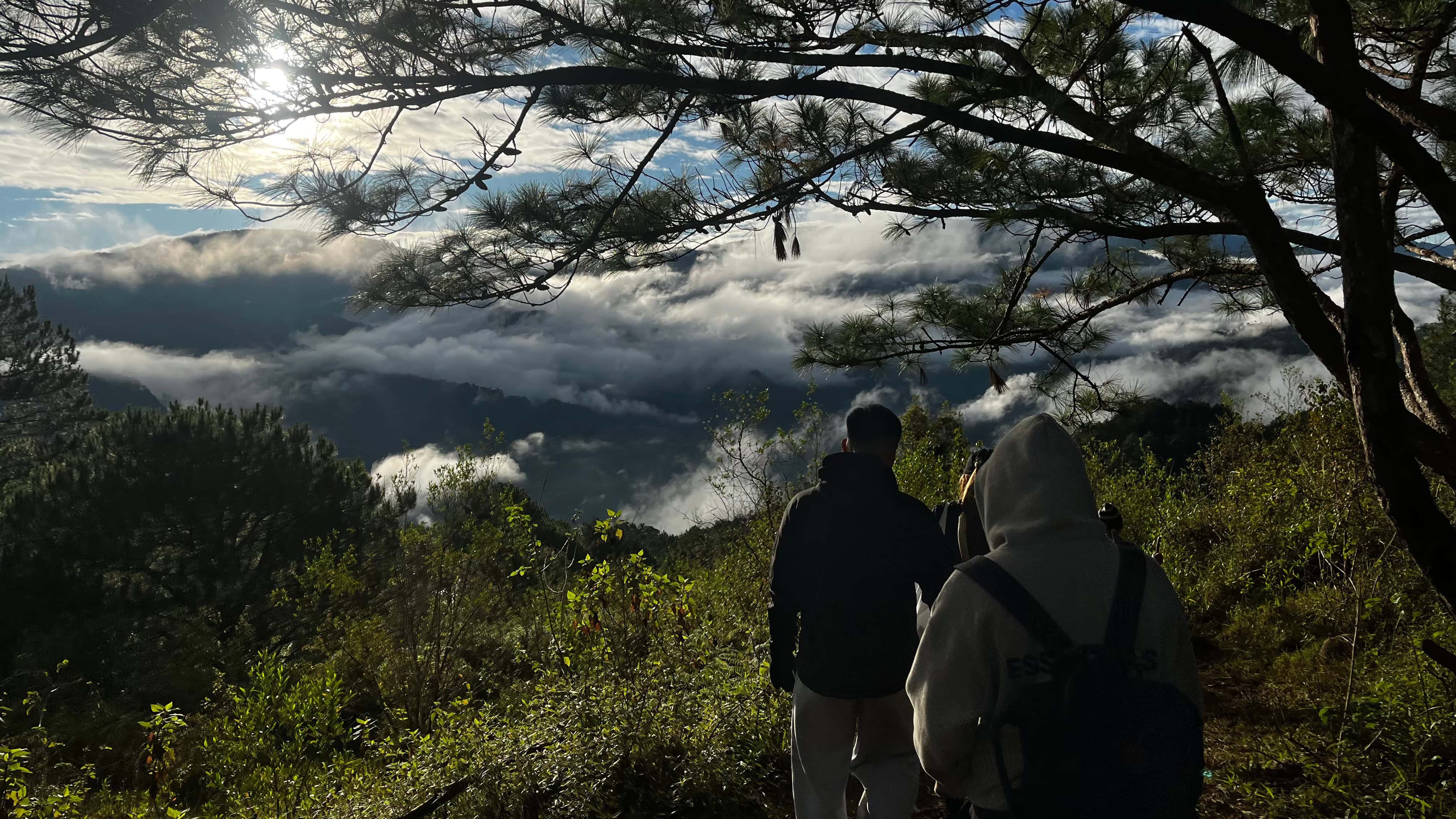
The Marlboro Hills and Blue Soil trek is one of the most popular hiking experiences in Sagada. Many travelers visit the rolling hills before sunrise to watch the first light spread across the mountains, often hoping to catch the famous sea of clouds that occasionally forms over the valley.
But the trek is more than just a sunrise viewpoint. Most hikers continue from Marlboro Hills down to Blue Soil, locally known as Kaman-utek, completing a longer trail that combines open hills, forest paths, and rocky descents before ending at a roadside exit outside town.
I did the full Marlboro Hills–Blue Soil trek as a joiner tour shortly after arriving in Sagada. The hike started before sunrise, the trail was muddy from the night’s moisture, and the morning did not deliver the dramatic sea of clouds many people imagine. Instead, the mountains appeared in shifting layers of fog, barely visible through moving clouds.
And strangely, that quiet, imperfect sunrise made the experience feel more real.
If you’re planning to hike Marlboro Hills and Blue Soil, this guide walks through the actual route, the real costs of the tour, how difficult the trek felt on the ground, and what future hikers should realistically expect when doing this early-morning Sagada hike.
Marlboro Hills & Blue Soil Trek — Quick Facts
Location: Sagada
Meetup Point: Near the Sagada Municipal Tourism Office
Meetup Time: Around 4:30 AM
Total Duration: About 4–5 hours
Route: Marlboro Hills → Blue Soil (Kaman-utek) → roadside exit
Difficulty Level: Moderate (muddy trail, rocky descent sections)
Guide Required: Yes, arranged through local tour operators
Registration Fee: ₱100 (tourism registration)
Insurance Fee: ₱150 (recommended for hikes and other risky activities)
Guide Fee: ₱1600 per group (shared among hikers)
Shuttle Fee: ₱1300 per group (shared among hikers)
Typical Finish Time: Around 9:00 AM back in town
Cost of the Marlboro Hills and Blue Soil Trek
Before doing activities like hiking in Sagada, visitors are required to register at the Sagada Municipal Tourism Office. During my visit, the tourism registration fee was ₱100, and I also purchased tourist insurance for ₱150, which is recommended for activities that involve potential risk such as trekking or caving.
These two payments are general tourism requirements for your stay in Sagada, not fees specific to the Marlboro Hills and Blue Soil trek itself.
For the hike, I booked through SEGA, a local tour operator in Sagada, and joined the trek as part of a small group.
The tour costs arranged by the operator were:
- Guide fee: ₱1600 per group
- Shuttle fee: ₱1300 per group
Because there were nine hikers in our group, these costs were divided evenly among us. That meant each person paid roughly ₱322 for the guide and transportation combined.
In other words, the only costs directly tied to the Marlboro Hills–Blue Soil trek were the shared guide and shuttle fees, while the tourism registration and insurance are general requirements for visitors doing activities in Sagada.
Registering at the Sagada Tourism Office
When I first arrived in Sagada, one of the first things I did was head straight to the Sagada Municipal Tourism Office to complete the required visitor registration.
The process was straightforward. Visitors register their stay, pay the environmental fee, and can also purchase tourist insurance if they plan to participate in activities like hiking, trekking, or caving.
I completed my registration immediately after arriving in town, which made it easier to arrange tours afterward. Later that same day, I went to the office of the tour operator SEGA and told them I wanted to join the Marlboro Hills and Blue Soil trek. They said they would confirm if there was an available group, and around 5 PM that afternoon, they called to let me know I could join the hike scheduled for the next morning.
Because the trek starts early, having the registration and tour arrangements settled the day before helps make the process much smoother.
Starting the Trek: The 4:30 AM Meetup
The Marlboro Hills–Blue Soil trek started early. Our group met at around 4:30 AM near the Sagada Municipal Tourism Office in the center of Sagada, where a van arranged by the tour operator was already waiting.
The morning air was extremely cold. It was the kind of cold where you could actually see your breath while talking. Most of the hikers were wearing multiple layers, bonnets, and gloves just to stay warm while waiting for everyone to gather.
Once the group was complete, we boarded the van and drove to the jump-off point. The ride itself was short, taking less than ten minutes along a paved road. Because it was still completely dark outside, there wasn’t much to see yet of the surrounding landscape.

At the jump-off point, there was already a small vendor stall open. They were selling items like scarves, gloves, and food and drinks for hikers who realized they needed extra warmth before starting the trek. Our guide gave the group several lamps to use for the hike, since the first part of the trail would be done entirely in the dark.
After a short briefing and a few minutes to prepare, we turned on our lamps and began walking into the trail toward Marlboro Hills.
Hiking to Marlboro Hills Before Sunrise
The hike began immediately after leaving the jump-off point. As soon as we stepped away from the road, the trail disappeared into darkness. The only visibility came from the lamps our guide handed out and the scattered beams of light from other hikers moving ahead along the path.
The ground was damp from the night’s moisture, and the trail was muddy in many places. Most of the route followed a narrow dirt path mixed with loose rocks and patches of wet soil. Because of the mud, several sections were slippery enough that hikers had to slow down and watch their footing carefully.
At times, the easiest way to move forward was to step on fallen branches or exposed roots to avoid sinking into the mud. Even though the hike itself wasn’t extremely steep, the trail demanded attention because of the combination of mud, darkness, and uneven ground. I nearly slipped multiple times despite moving cautiously.
The incline during this first stretch was mostly gradual, with occasional parts where the path became slightly steeper. The trail wound through what seemed like a pine forest, although it was difficult to clearly see the surroundings because the entire hike was happening before sunrise.
Our guide stayed near the back of the group, making sure slower hikers weren’t left behind. The rest of us naturally spread out along the trail depending on our pace. There weren’t any formal rest stops during this section, but hikers were free to pause whenever they needed to catch their breath.
After roughly thirty to forty minutes of walking, the forest path began to open up. Instead of trees closing in around the trail, the space ahead widened, and faint shapes of structures started to appear in the distance. These turned out to be the small vendor stalls and seating areas near the Marlboro Hills viewpoint.
Even before the sunrise began, it was already clear that this was where most hikers gathered to wait for the morning view.
Waiting for Sunrise at Marlboro Hills

When we reached the Marlboro Hills viewpoint, the first thing I noticed was that the place was already prepared for sunrise visitors.
Several small booths were set up along the hill, selling food, drinks, and small items for hikers who had just finished the climb. Behind the stalls were a few tables and chairs where people could sit down while waiting for the sunrise. Two bonfires were burning nearby, and a small crowd had gathered around them to warm their hands.

The cold was intense. Many hikers were wearing multiple layers, bonnets, gloves, and thick jackets. Some were already holding cups of coffee or bowls of hot porridge, trying to warm up after the hike. Others were still adjusting their cameras and tripods while scanning the horizon.
Our group had arrived fairly early, so the hills were still quiet when we got there. Only a few tourists were already waiting, and most of them had spread out across the grassy slopes to claim their own viewing spots. The space felt wide and open. Instead of clustering together, people naturally drifted toward different parts of the hill depending on where they thought the best view might be.
I rested for a moment first. I placed my bag on one of the tables, walked over to the bonfire to warm up, and started preparing my camera gear. After a while, I bought a cup of coffee from one of the stalls and began moving around the hill, trying to decide where to position myself once the light started coming in.


More hikers slowly began arriving behind us. Even so, the atmosphere remained calm. Conversations stayed quiet, footsteps were slow, and most people were simply looking out toward the mountains, waiting for the sky to change.
The anticipation was there. Everyone had come for the sunrise.
But that morning, the mountains had something slightly different in mind.
When the Sea of Clouds Does Not Appear

One of the main reasons hikers wake up early for the Marlboro Hills sunrise trek is the possibility of seeing the famous sea of clouds. Under the right conditions, thick clouds fill the valley below while the surrounding mountains rise above them. This is the view most people hope to see when they hike up the hills before sunrise.
However, the conditions at Marlboro Hills can change quickly, and the sea of clouds does not appear every morning.
During my hike, the sunrise did not produce the dramatic view that many travelers expect. Instead of a clear horizon and a valley full of clouds, the mountains appeared in faint layers behind moving fog. At times, the clouds covered the ridges completely. Then a few moments later, parts of the landscape would reappear as the fog shifted across the hills.
There was no single moment when the sky suddenly opened up and revealed a panoramic sunrise. The light gradually changed, but the clouds remained thick enough that the view stayed muted for most of the morning.
This is something worth keeping in mind when planning the Marlboro Hills hike. Weather conditions in the mountains are unpredictable, and the sea of clouds is never guaranteed. Some mornings produce spectacular views, while other mornings feel quieter and more atmospheric.
Even without the classic sea-of-clouds moment, the experience of standing on Marlboro Hills at sunrise can still be rewarding. Watching the clouds move across the mountains and seeing the landscape slowly emerge through the fog gives the place a different kind of beauty that photographs rarely capture.
Descending from Marlboro Hills to Blue Soil

After spending some time at the viewpoint, our guide eventually gathered the group and told us it was time to continue the trek. The reason was simple. If we moved ahead early, we could stay in front of the larger groups that were still arriving at Marlboro Hills.
Before heading down toward Blue Soil, a few of us briefly walked to a lower viewpoint nearby. The fog was still thick, and the mountains were barely visible, so we did not stay there long. Soon after, we began the descent toward the next part of the trail.
The terrain changed almost immediately.
While the hike up to Marlboro Hills followed a muddy forest trail, the route toward Blue Soil involved a much rockier descent. The path was still a mix of dirt and grass in some sections, but many parts of the trail were covered with loose rocks and uneven stones. Several of these rocks were angled and sharp, which made it necessary to slow down and watch every step.

The slope itself was not extremely steep, but the rocky ground made the descent feel more technical than the earlier climb. In my experience, this section was the most challenging part of the entire trek. I had to reduce my pace significantly just to keep my balance.
Some hikers moved through the descent without much trouble, but others took longer. At one point, a couple from another group was noticeably behind because the terrain forced them to take their time navigating the rocks.
Another factor that made this section slightly tricky was that parts of the trail were not always clearly defined. In some areas, multiple faint paths seemed to branch out across the slope. Because of this, most hikers relied on their guide and simply followed the direction of the group ahead.

From Marlboro Hills, the hike to Blue Soil typically takes around 40 minutes to an hour, depending on the pace of the group and how carefully hikers move through the rocky sections.
Eventually, the trail began to level out, and the landscape ahead started to open again. That was when we knew we were approaching the Blue Soil area, the next major stop of the trek.
Arriving at Blue Soil (Kaman-utek)

After about forty minutes to an hour of walking from Marlboro Hills, the trail gradually opened up again and we arrived at the Blue Soil area, locally known as Kaman-utek. This is the second major stop of the trek and one of the more unusual landscapes around Sagada.
At first glance, the terrain looks very different from the grassy hills of Marlboro. The ground here has a bluish-gray tint caused by mineral deposits in the soil. In photos online, the hills sometimes appear vividly blue, which often leads visitors to expect a much stronger color when they arrive.
In reality, the color is usually more subtle. Parts of the ground appear faintly blue or gray depending on the lighting and moisture in the soil. Some sections also look rocky rather than smooth, especially in areas that have seen frequent foot traffic over the years.
One important rule that guides consistently remind visitors about is that hikers are no longer allowed to climb the Blue Soil hills themselves. Walking on the hills damages the surface and affects the appearance of the soil over time. Because of this, visitors are asked to stay around the surrounding paths rather than stepping onto the hills.
The area also functions as a natural rest stop for hikers finishing the first half of the trek. There were several tables set up where people could sit and recover from the walk. A small vendor stall was also operating nearby, selling drinks and simple food for hikers who needed a break before continuing.
By the time we arrived, many people were resting, taking photos, or simply sitting down after the descent from Marlboro Hills. One detail that was hard to miss was the presence of horse droppings scattered across parts of the ground. This is apparently common in the area because wild horses are sometimes seen roaming around the surrounding hills, although we did not encounter any during our trek.
Our group spent roughly thirty minutes here. Most people used the time to rest, buy drinks, or take photos before preparing for the final part of the hike back toward the road.
Can You Climb the Blue Soil Hills?


No. Visitors are no longer allowed to climb the Blue Soil hills.
In the past, hikers often walked directly on the hills, which made them a popular photo spot. Over time, however, this began to damage the surface of the soil and affect the appearance of the area. Because of this, local guides now remind visitors to stay on the surrounding paths instead of stepping onto the hills themselves.
During our stop at Blue Soil, the guide made it clear that hikers should only walk around the designated areas. People were free to explore the nearby paths, take photos, and rest at the tables near the vendor stalls, but the hills themselves were off-limits.
Following this rule helps preserve the landscape so that future visitors can still see the unique mineral soil that gives Blue Soil its name.
Final Descent and Return to Town
After spending some time resting at Blue Soil, our guide gathered the group and signaled that it was time to finish the trek. From this point, the remaining trail led downhill toward the road where the shuttle would pick us up.
Compared to the rocky descent from Marlboro Hills, this last section of the hike felt easier. The trail was still a mix of dirt and rocks, but the terrain was less technical and the path was easier to follow. Most of the challenge at this stage came from simple fatigue. By then, we had already been walking for several hours, and the earlier sections of the trail had started to catch up with everyone.
The descent from Blue Soil to the roadside exit usually takes around 20 to 30 minutes, depending on the pace of the group. Some hikers moved faster, while others took their time to avoid slipping on loose stones along the path.
Eventually, the trail ended at a roadside pickup point located in front of a small souvenir shop. Our shuttle van was already waiting there, ready to bring us back to town.
From the pickup point, the ride back to the center of Sagada took roughly 15 minutes. The van dropped us off again near the Sagada Municipal Tourism Office, which was the same area where we had met earlier that morning.
By the time we returned, it was already close to 9 AM, marking the end of the Marlboro Hills and Blue Soil trek.
How Difficult Is the Marlboro Hills and Blue Soil Trek?
The Marlboro Hills and Blue Soil trek is generally considered a moderate hike, although the level of difficulty can vary depending on preparation, weather conditions, and individual fitness.
The hike itself does not involve extreme elevation gains or technical climbing, but several factors make it more demanding than it might initially appear. One of the biggest challenges is that the trek begins before sunrise, which means the first part of the trail is done entirely in the dark. Even with lamps, hikers still need to pay attention to their footing because the path can be muddy and narrow in certain sections.
The trail conditions also play a role in the perceived difficulty. The early part of the hike follows a dirt path that often becomes muddy due to overnight moisture. Later in the trek, the descent from Marlboro Hills toward Blue Soil involves rocky terrain where many of the stones are angled or uneven. This section requires slower and more careful movement to avoid slipping.
In my case, the hike felt moderately difficult because of several personal factors. I had just arrived in Sagada the day before, did not get much sleep, and was wearing regular sneakers instead of proper hiking shoes. Under those conditions, the combination of mud, rocks, and fatigue made certain parts of the trek more tiring than expected.
However, for hikers who are reasonably fit, well rested, and wearing proper footwear, the Marlboro Hills and Blue Soil trek is very manageable. Taking a steady pace and watching your footing during the rocky descent are usually enough to complete the hike comfortably.
If you want to see more of the landscapes around Marlboro Hills, Blue Soil, and the quiet mountain mornings of Sagada, I documented the trip in a cinematic film on my YouTube channel, In The Breath of the Mountains: Two Weeks in Sagada.
Food and Vendor Stops Along the Trail


One detail that surprised me about the Marlboro Hills and Blue Soil trek was the number of small vendor stalls along the route. For a hike that begins before sunrise and passes through open hills and forest trails, I did not expect to see several places where hikers could buy food and drinks.
The first stall was located at the jump-off point. This was where many hikers made last-minute purchases before starting the hike. Vendors were selling items like scarves, bonnets, gloves, and simple food and drinks for those who wanted something warm before heading into the trail.
The second group of stalls appeared at Marlboro Hills itself, near the main viewpoint area. This is where most hikers gather while waiting for the sunrise. Vendors here were selling hot drinks and breakfast-style food, which many hikers bought while sitting near the bonfires or resting at the tables behind the stalls.
Between Marlboro Hills and Blue Soil, we also encountered a midpoint stall along the trail. It was a simple setup, but it offered another opportunity for hikers to buy drinks or quick snacks during the descent.
Finally, there was another vendor stall at Blue Soil, which functioned as a natural rest stop for many groups finishing the first half of the trek. Tables were set up nearby where hikers could sit down, eat, and recover before starting the final descent back to the road.
The food options were simple but surprisingly varied for a trail setting. During the hike, I saw vendors selling coffee, champorado, porridge, eggs, lumpiang togue, bottled water, and soft drinks.
Because of these stalls, hikers technically do not need to carry large amounts of food. However, it is still a good idea to bring some water or cash in case you want to buy drinks or snacks along the way.
What Surprised Me Most About the Trek


Before doing the Marlboro Hills and Blue Soil trek, I had a fairly simple expectation. I thought it would mostly be about reaching the hills, watching the sunrise, and then walking down to Blue Soil afterward.
In reality, several parts of the experience turned out to be different from what I expected.
The first surprise was the cold temperature before sunrise. Sagada’s mountain climate can feel much colder than visitors anticipate, especially before the sun comes up. Many hikers were wearing multiple layers, bonnets, and gloves just to stay warm while waiting at the viewpoint.
Another unexpected detail was the presence of bonfires and food stalls at Marlboro Hills. Seeing vendors selling hot coffee and porridge on a hilltop before sunrise created a very different atmosphere from the quiet, isolated mountain scene I had imagined.
The muddy trail conditions were also more noticeable than I expected. Because the hike starts early in the morning, the ground is often damp from overnight moisture. This makes parts of the path slippery, especially in narrow sections of the forest trail.
The rocky descent from Marlboro Hills to Blue Soil was another moment that stood out. While the initial climb to the hills was manageable, the rocks along the downhill route required careful footing and forced many hikers to slow their pace.
Finally, I was surprised by how tiring the trek felt by the end, even though the total distance is not extremely long. The early wake-up, the muddy terrain, and the rocky sections gradually add up, and by the time we reached the roadside pickup point, most of the group was already feeling the effects of several hours of hiking.
These small details are part of what makes the Marlboro Hills and Blue Soil trek more than just a sunrise viewpoint. The experience is shaped as much by the trail itself as by the landscape at the top.
What to Bring for the Marlboro Hills Sunrise Trek
Preparing properly for the Marlboro Hills and Blue Soil trek can make the hike much more comfortable, especially since the activity begins before sunrise and passes through muddy and rocky sections of trail.
One of the most important things to bring is proper footwear. While it is possible to complete the hike with regular sneakers, doing so can make the rocky and muddy sections more difficult to navigate. In my case, I only had regular sneakers with me, and although I was able to finish the trek, there were several moments where better hiking shoes would have made the descent easier and more stable.
Carrying water is also recommended. I chose not to bring a water bottle because I wanted to avoid carrying extra weight, which turned out to be both convenient and inconvenient at the same time. While it kept my bag lighter, it also meant I had to buy drinks from the vendors along the trail. The stalls made this possible, but relying entirely on them can be less flexible than simply bringing your own water.
Since the trek begins before sunrise, warm clothing is another practical item to prepare. Many hikers wear jackets, bonnets, or gloves while waiting for the sunrise at Marlboro Hills. Temperatures can feel surprisingly cold in the early morning, especially when standing still at the viewpoint.
It is also helpful to bring some cash. Several small vendor stalls appear along the route, including at the jump-off point, Marlboro Hills, and Blue Soil. These stalls sell items such as coffee, porridge, snacks, and bottled drinks, and having cash makes it easier to buy something if you need it during the hike.
For those who plan to document the experience, bringing light camera gear is enough for most situations. I only carried my iPhone 13 and a small camcorder, which were more than sufficient for capturing the hike and the changing conditions during sunrise.
Packing light but practical items will make the trek smoother, especially during the rocky descent and the final stretch of the hike.
If you want to see more of the atmosphere around Marlboro Hills, Blue Soil, and the surrounding landscapes of Sagada, I documented the trip in a cinematic film on my YouTube channel, In The Breath of the Mountains: Two Weeks in Sagada.
Best Time to See the Sea of Clouds at Marlboro Hills
Many hikers visit Marlboro Hills specifically to see the sea of clouds that sometimes forms over the valleys around Sagada. When conditions are right, thick clouds settle below the surrounding mountain ridges while the hills remain clear above them, creating the layered landscape that often appears in photos of the area.
However, this phenomenon is highly dependent on weather conditions and is never guaranteed.
I did the Marlboro Hills trek during the first week of January. On that morning, the sky remained foggy and the mountains appeared only faintly through shifting clouds. Instead of a dramatic sea of clouds, the landscape stayed mostly covered in mist for most of the sunrise period.
According to some locals I spoke with, the chances of seeing the sea of clouds can sometimes be better around the warmer months, with May often mentioned as a time when the conditions are more favorable. Still, even during those periods, the appearance of the sea of clouds depends on temperature changes, humidity, and wind patterns.
For hikers planning the trek, it is best to approach the sunrise experience with flexible expectations. Some mornings reveal spectacular views across the mountains, while others remain quiet and foggy. Either way, the experience of hiking through the hills before sunrise and watching the light gradually change across the landscape remains one of the most memorable parts of the trek.
Where I Stayed Before the Trek
Because the Marlboro Hills trek starts early in the morning, staying somewhere close to the town center can make the experience much easier.
During my first week in Sagada, I stayed at Tanap Dwelling Inn. The inn is located within walking distance of the town center and it took me less than five minutes on foot to reach the meetup point near the Sagada Municipal Tourism Office.
This short distance made a noticeable difference, especially because the meetup time for the trek was around 4:30 in the morning. Instead of worrying about transportation or walking long distances in the dark, I could simply leave the inn and arrive at the meeting point within a few minutes.
For travelers planning to do early morning activities like the Marlboro Hills sunrise hike, choosing accommodation near the town center can make the early start much more manageable.
Is the Full Marlboro Hills and Blue Soil Trek Worth It?

For most visitors, the main reason to wake up early and hike to Marlboro Hills is the sunrise. When conditions are right, the sea of clouds can create one of the most striking views in Sagada. Because of this, some travelers choose to visit only Marlboro Hills and skip the rest of the trail.
But completing the full Marlboro Hills and Blue Soil route offers a more complete hiking experience.
The trek does not end at the viewpoint. Continuing down toward Blue Soil adds another dimension to the journey. The terrain changes from grassy hills to rocky trails, and the hike becomes less about waiting for a view and more about moving through the landscape itself. By the time you reach Blue Soil and eventually descend to the roadside exit, the trek feels like a proper half-day hike rather than just a sunrise stop.
That said, the right choice depends on what you are looking for.
If your main goal is simply to see the sunrise or catch the sea of clouds, visiting Marlboro Hills alone may already satisfy that expectation. But if you want the full experience of the trail, including the descent to Blue Soil and the walk through the surrounding hills, completing the entire route is worth the extra effort.
For me, doing the full trek made the morning feel more complete. Even though the sunrise that day did not produce the dramatic sea of clouds many people hope for, the combination of the hike, the changing terrain, and the quiet atmosphere of the mountains made the experience memorable in its own way.
The Marlboro Hills and Blue Soil Trek Beyond the Postcard View

The Marlboro Hills and Blue Soil trek is often presented as a sunrise hike defined by one moment. The sea of clouds rolls in, the mountains rise above the mist, and the entire landscape looks like something pulled from a travel poster.
But the experience on the ground is usually more complicated than that.
The trail itself plays a big part in the journey. The muddy climb in the dark, the quiet wait on the hills before sunrise, the rocky descent toward Blue Soil, and the gradual return to town all shape how the morning unfolds. The trek becomes less about a single perfect photograph and more about moving through the landscape as the day slowly begins.
In my case, the famous sea of clouds never appeared. Instead, the mountains revealed themselves through shifting fog, sometimes visible and sometimes hidden behind moving clouds. It was not the cinematic sunrise many people expect when they first hear about Marlboro Hills.
Yet the experience still felt complete.
Walking through the hills before the rest of the town wakes up, watching the light change across the mountains, and finishing the trek hours later with tired legs gave the morning a quiet rhythm that photographs rarely capture.
For travelers visiting Sagada, the Marlboro Hills and Blue Soil trek is worth doing not only for the view that might appear at sunrise, but for the entire journey that surrounds it.
Frequently Asked Questions About the Marlboro Hills and Blue Soil Trek
How long does the Marlboro Hills and Blue Soil trek take?
The full trek usually takes around 4 to 5 hours from start to finish. Most groups meet around 4:30 AM near the Sagada Municipal Tourism Office, hike up to Marlboro Hills for sunrise, continue down to Blue Soil, and then descend to a roadside pickup point before returning to town.
Do you need a guide to hike Marlboro Hills and Blue Soil?
Yes. Hiking activities in Sagada are typically organized through registered guides. Visitors usually arrange tours through local operators, who then provide both a guide and transportation to the jump-off point.
How much does the Marlboro Hills and Blue Soil trek cost?
The main costs are the guide and shuttle fees arranged through tour operators.
Guide fee: ₱1600 per group
Shuttle fee: ₱1300 per group
These costs are shared among the hikers in the group. In my case, nine people joined the trek, so each person paid roughly ₱322 for the guide and transportation combined.
Visitors must also register at the Sagada Tourism Office and pay the standard tourism fee and optional insurance, which apply to activities across Sagada.
Is the Marlboro Hills and Blue Soil trek beginner friendly?
Yes, most reasonably fit travelers can complete the trek. The hike is not extremely steep, but certain parts of the trail can be muddy or rocky, especially during the descent from Marlboro Hills toward Blue Soil. Moving at a steady pace and wearing proper footwear usually makes the hike manageable.
Is Blue Soil actually blue?
The ground at Blue Soil, also known as Kaman-utek, has a bluish-gray tint caused by mineral deposits in the soil. The color is usually subtle rather than bright blue, and the appearance can change depending on lighting and soil moisture.
Are there food stalls along the trail?
Yes. During the hike, small vendor stalls appear at several points along the route, including the jump-off area, Marlboro Hills, a midpoint between the hills and Blue Soil, and the Blue Soil rest area. Vendors typically sell coffee, champorado, porridge, eggs, lumpiang togue, bottled water, and soft drinks.
Is Marlboro Hills worth visiting if the sea of clouds does not appear?
Yes. While many hikers hope to see the sea of clouds during sunrise, the trek itself still offers a rewarding experience even when the weather is foggy. The rolling hills, early morning atmosphere, and the full route to Blue Soil make the hike worthwhile regardless of the exact sunrise conditions.
Can visitors climb the Blue Soil hills?
No. Visitors are no longer allowed to climb the Blue Soil hills because walking on them damages the surface of the soil. Hikers are asked to stay on the surrounding paths to help preserve the landscape.
If you found this piece insightful, consider supporting my work – every contribution helps fuel more in-depth stories, reflections, and meaningful content. Support here!