
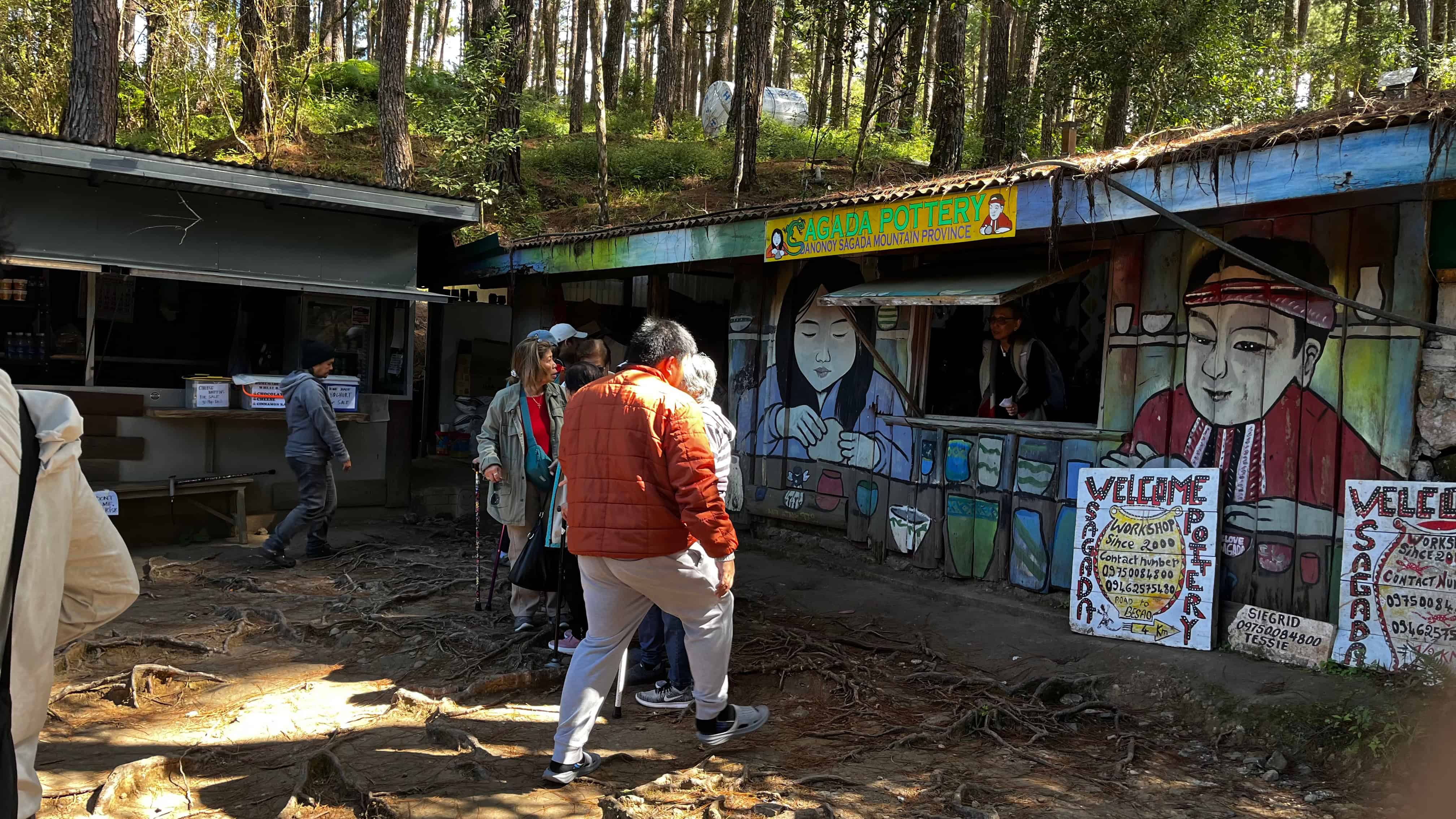
Sagada is best known for its caves, sunrise hikes, and the famous hanging coffins. But beyond the mountains and viewpoints, there are quieter experiences that allow visitors to slow down and connect with the town’s craft traditions.
One of these is Sagada Pottery, a working pottery studio where travelers can watch local potters demonstrate their craft and even try shaping clay on the wheel themselves.
If you’re planning to visit, this guide covers the Sagada Pottery price, location, and what to expect during the pottery workshop, based on my own experience trying the wheel and making a bowl during my stay in Sagada.
Where Is Sagada Pottery Located?
Sagada Pottery is located just outside the main town center of Sagada, near House of Sol and Sagada Cellar Door. Because these places are relatively well known among travelers staying in the area, they serve as useful landmarks when trying to find the pottery studio.
From the Sagada town center, the workshop is technically within walking distance. However, the route going there involves a steady uphill climb. While it’s not extremely far, the incline can make the walk feel longer and more tiring than expected, especially if you’re already coming from a day of exploring caves, waterfalls, or sunrise viewpoints.
For most visitors, the easier option is to take a tuktuk ride from the town proper. The ride only takes a few minutes and typically costs around ₱25 per person. Even if you’re traveling with someone else, the fare is usually still charged per passenger.
Once you arrive at Sagada Pottery, the entrance is easy to recognize. Near the front of the property, there’s a small store that sells various locally made products and souvenirs such as jams and other items that tourists often bring home from Sagada. This small shop acts as a sort of welcome point for visitors. The staff stationed there usually greets guests and directs them toward the pottery workshop area just inside the property.
Sagada Pottery Price
Sagada Pottery has a few different costs depending on how far you want to take the experience, so it helps to understand the pricing before you go.
During my visit, the pottery demonstration fee was ₱300. This covers the live demo given by one of the potters, where visitors are shown how the clay is centered on the wheel, opened in the middle, and gradually shaped into its initial form. The demonstration also includes an explanation of how the pottery process works beyond the wheel, from drying and trimming to firing and glazing. Since this is the part where visitors get to observe the craft more closely before trying it themselves, it already gives value even before you touch the clay.
If you want to try the wheel yourself, the pottery experience fee is ₱100. This is the part where visitors get to sit down, work with the prepared clay, and shape their own piece with the potter guiding them through the process. The actual wheel time is short, but it gives you a much better appreciation of how much control, sensitivity, and hand feel pottery really requires.
If you decide that you want to keep the piece you made, there is an additional ₱950 processing fee. This covers the full ceramic process after shaping, including drying, trimming, glazing, and firing. Since pottery cannot be finished on the same day, this fee is what allows your piece to be turned from wet clay into an actual finished ceramic item.
For those who cannot return to Sagada, the finished pottery can also be shipped for an additional fee. In my case, I chose not to have my bowl shipped out immediately. Instead, I arranged for it to be delivered to Greenhouse Inn, the second inn where I stayed in Sagada, since I am planning to return in May and pick it up then.
As a whole, the pricing at Sagada Pottery makes more sense when you think of it in layers: there is the demo, the hands-on wheel experience, and then the optional full processing if you want to keep what you made. That structure is useful to know before visiting, especially if you want to decide in advance whether you are just there to observe, to try the wheel, or to come away with a finished piece.
What Happens During the Sagada Pottery Workshop?
The Sagada Pottery workshop begins the moment you step inside the main studio area. After being directed in from the small shop near the entrance, visitors are usually welcomed by one of the potters and asked to take a seat while the demonstration begins.
During my visit, the potters working inside the studio were all women. As soon as we were seated, one of them began the pottery demonstration. The clay was already prepared on the wheel, and while the demo was happening, there were also other visitors inside the workshop doing their own sessions. Despite several activities happening at the same time, the studio never felt chaotic. The space is large enough to accommodate multiple demonstrations and visitors, and the environment felt surprisingly calm and relaxed.
The Pottery Demonstration
The demonstration starts with the potter explaining how the clay is prepared and where it comes from. According to the potter guiding us, they do not actually mine clay themselves. Instead, they collect clay remnants from mining areas and other natural clay sources that are freely available in the environment.
Once the explanation begins, the potter starts working with the clay on the wheel. The first step is centering the clay, which means stabilizing it at the middle of the spinning wheel. With steady pressure from both hands, the potter gradually presses the clay down and shapes it into a balanced form.
From there, she pushes her thumbs into the center of the clay to create a hollow. As the wheel continues to spin, the clay slowly rises upward as she guides it with both hands, eventually forming a cylinder, which is the base shape used before turning the clay into bowls, cups, or other forms.
One thing the potter emphasized during the demonstration is that pottery is largely about feeling the clay. Potters rely on touch to determine how thick or thin the clay is becoming while shaping it. Knowing when to stop applying pressure is just as important as knowing when to continue shaping.
She also explained that the work done on the wheel is only the beginning of the pottery process. After shaping, the piece needs to go through several stages before it becomes a finished ceramic item. The clay is first air dried for about five days until it reaches what potters call a “leather dry” stage. At that point, excess clay is trimmed away.
After trimming, the pottery is left to dry for about another month. Only after it has fully dried can it be placed inside the kiln. The piece is fired twice in total. The first firing strengthens the clay, while the second firing happens after glaze is applied, giving the pottery its finished surface.
Watching this demonstration already gives visitors a deeper appreciation for how much patience and care goes into a single piece of pottery.
Trying the Pottery Wheel


After the demonstration, visitors who want to try the wheel are invited to sit down and attempt shaping the clay themselves.
This part of the experience costs ₱100, and one of the potters guides you step by step while the wheel spins. The clay itself feels very soft when you first touch it, and because water is used during shaping, your hands quickly become messy as you work the clay between your fingers.
Despite that, the overall feeling while shaping the clay was surprisingly calm. With the wheel spinning and the potter guiding my hands, the experience felt almost zen-like, even if I was still figuring out what I was doing.
One funny detail during my turn was that the potter kept pointing out how long my nails were. Because of that, my nails ended up doing some of the shaping instead of just my fingertips. Even so, with her help, I managed to shape a bowl that ended up looking a lot like a ramen bowl by the time we were done.
The actual time spent shaping the clay is quite short, usually less than five minutes. But even within that brief moment, you start to understand how much control and sensitivity is required to work with clay properly on the wheel.
What Happens to the Pottery After You Finish?

Once you finish shaping your piece on the pottery wheel, the potter carefully removes it so it can begin the long process of becoming an actual ceramic item.
The first step is separating the clay from the wheel. The potter does this by sliding a thin string underneath the clay, gently cutting it free from the spinning surface. This prevents the shape from collapsing while it is being moved.
After the piece is removed, the potter writes your name directly on the clay so it can be identified later, especially since multiple visitors may be making pottery during the day. Your bowl or pottery piece is then placed on a wooden board where it will start drying along with other newly shaped pieces.
At this point, visitors are usually given a quick photo opportunity with the pottery they made before it continues into the next stages of the process.
From there, the pottery follows a much longer timeline before it becomes a finished ceramic item. According to the potter who guided the demonstration, the clay must first be air dried for around five days until it reaches what potters call a leather-dry stage. Once it reaches that point, the potters trim away excess clay to refine the shape.
After trimming, the piece is left to air dry for about another month. Only when the clay has completely dried can it be placed inside the kiln for firing. The pottery is fired twice in total. The first firing strengthens the clay and turns it into a solid ceramic form. After that, glaze is applied to the surface, and the piece goes through a second firing to produce the finished result.
Because of this long process, visitors cannot take their pottery home immediately after making it.
However, Sagada Pottery gives visitors the option to have their piece fully processed if they want to keep it. For an additional ₱950 processing fee, the studio handles the drying, trimming, glazing, and firing so that your clay creation becomes a finished ceramic item.
In my case, I decided to go through with the full process because I wanted to keep the bowl I made during the workshop. Instead of paying for shipping, I arranged for the finished piece to be delivered to Greenhouse Inn, the second place I stayed at in Sagada. Since I plan to return to Sagada in May, I’ll simply pick up the bowl then once it has completed the full pottery process.
What the Sagada Pottery Studio Feels Like
One of the things that stood out to me about Sagada Pottery was the atmosphere inside the studio. Despite being a place that regularly receives visitors, the workshop does not feel overly commercial or staged for tourism.
The main pottery area is open and spacious, without doors separating the workspace from the rest of the studio. Because of this layout, visitors can freely see what is happening around them while the potters work. The environment feels more like stepping into a real working studio than entering a typical tourist attraction.
All around the workshop, you’ll see rows of finished and unfinished pottery displayed on shelves and tables. Bowls, cups, jars, vases, and other ceramic pieces are placed throughout the space, showing the variety of items produced by the studio. Some pieces are fully finished and ready to be sold, while others are still drying or waiting for the next stage of the process.
One detail that immediately catches your attention is the kiln used for firing the pottery, which is visible within the workshop area. Seeing the kiln in the same space where the pottery is shaped helps make the entire process feel more tangible. It becomes clear that the pieces being made here go through several stages before they end up as finished ceramics.
Even with multiple visitors inside the workshop during my visit, the atmosphere remained calm and relaxed. People quietly watched the demonstrations, others waited for their turn at the wheel, and the potters moved through their work with a steady rhythm. Nothing felt rushed.
Because of this, Sagada Pottery does not come across as just another stop on a tourist itinerary. It feels like a real craft space, where visitors are simply given the chance to briefly step into the process and try the wheel themselves.
Are the Potters Friendly?
Before visiting Sagada Pottery, I had actually seen a number of videos online claiming that the potters there could be rude or dismissive toward visitors. Some travelers shared stories about being reprimanded during the pottery session or feeling uncomfortable while trying the wheel.
Because of that, I arrived at the workshop with a bit of curiosity about whether that reputation was true.
From my experience, it was quite the opposite.
The potters guiding the sessions were clear, patient, and surprisingly gentle in their instructions. During the demonstration, the potter carefully explained each step of the process and took time to describe how the clay is shaped, how it dries, and how it eventually becomes a finished ceramic piece.
When it was time for visitors to try the wheel, the guidance felt supportive rather than strict. The potter stood beside me while the wheel spun and helped guide my hands as I shaped the clay. At no point did the atmosphere feel tense or uncomfortable.
In fact, there were even moments of light banter during the session. The potter repeatedly joked about how long my nails were, pointing out that they were getting in the way of shaping the clay properly. Because of that, some parts of the bowl ended up being shaped by my nails instead of just my fingertips, which turned into a funny moment during the experience.
Looking back, I suspect that the negative impressions shared online may come from a mismatch of expectations. Pottery is not just a quick tourist activity where you sit down for a photo and leave. Even in a short session, the craft requires attention, patience, and cooperation with the potter guiding you.
If visitors treat the activity too casually or ignore instructions, it can easily disrupt the process. Clay is delicate while it spins on the wheel, and small mistakes can cause the shape to collapse. Because of that, the potters naturally need visitors to listen carefully while they guide the process.
From what I observed, the potters at Sagada Pottery are not unfriendly. They simply treat the craft seriously. And when visitors approach the experience with the same level of respect and curiosity, the interaction becomes much more enjoyable.
For travelers who genuinely want to learn, try the wheel, and appreciate the craft behind the pottery, the atmosphere inside the workshop is welcoming, calm, and even playful at times.
Is the Sagada Pottery Experience Worth It?
For travelers looking for something different from Sagada’s usual hikes and cave adventures, the Sagada Pottery workshop offers a quieter and more reflective experience. Instead of climbing viewpoints or navigating underground caves, you sit down, slow your pace, and focus on shaping something with your own hands.
On paper, the actual pottery session is short. The time spent shaping clay on the wheel is usually less than five minutes, especially since the potter guides each visitor one at a time. Because of that, some people might initially feel that the activity is brief compared to other experiences in Sagada.
But the value of the experience does not really come from how long you spend on the wheel.
What makes the workshop worthwhile is the chance to step into the craft itself, even if only for a few minutes. Watching the potter demonstrate the process, feeling the clay move under your hands, and realizing how delicate the shaping process actually is quickly gives you a deeper appreciation for pottery as a craft.
For me personally, the most meaningful part of the experience was walking away knowing that I had actually made something. Even if it was just a bowl and even if the potter helped guide most of the process, the object that came out of that session felt different from the usual souvenirs you buy from shops. It was something I helped shape, and something that will go through the full pottery process before I can eventually pick it up.
That feeling also changed how I looked at the pottery pieces displayed around the studio. Seeing rows of bowls, cups, jars, and vases suddenly felt different once I understood the amount of time, patience, and attention required to create them.
Sagada Pottery is probably not the kind of activity that will appeal to everyone. Visitors who are only looking for quick photo opportunities might find the session too short. But for travelers who enjoy art, craftsmanship, or hands-on creative experiences, the workshop offers a small but meaningful moment during a trip to Sagada.
It is also a surprisingly peaceful activity compared to the more physically demanding attractions around town. Sitting at the wheel, focusing on the clay, and listening to the potter’s guidance creates a calm atmosphere that contrasts nicely with the usual rush of travel itineraries.
In that sense, Sagada Pottery is not just about trying a tourist activity. It is about briefly stepping into a craft that local artisans practice every day, even if only long enough to shape a bowl and leave it behind to finish its journey in the kiln.
If you want to see more of the atmosphere around Sagada beyond the pottery workshop, I documented the trip in a cinematic film on my YouTube channel, In The Breath of the Mountains: Two Weeks in Sagada.
Tips Before Visiting Sagada Pottery
If you’re planning to try the pottery workshop in Sagada, a few small details can make the experience smoother and more enjoyable. Because the activity is short and guided by the potters themselves, arriving with the right expectations and preparation helps you appreciate the craft more fully.
One of the first things to consider is transportation. While Sagada Pottery is technically within walking distance from the town center, the route going there involves a noticeable uphill climb. After a day of exploring Sagada’s caves, viewpoints, or hiking trails, that walk can feel more exhausting than expected. Taking a tuktuk ride instead is usually the easier choice. The ride only takes a few minutes and typically costs around ₱25 per person.
It’s also a good idea to bring cash when visiting the workshop. The pottery experience fees, including the demonstration, the wheel session, and the optional processing for finished pottery, are all paid on-site. Having cash ready makes the process much simpler.
Another small but surprisingly relevant detail is your fingernails. During my session, the potter repeatedly pointed out that my nails were quite long, which made it harder to control the clay with my fingertips. If you want to have a smoother experience shaping the clay, trimming your nails beforehand can actually help.
Visitors should also keep in mind that the actual wheel time is short, often lasting only a few minutes. This is because the potters guide each visitor one at a time, and the goal of the activity is to give people a brief but meaningful chance to try the craft rather than a long pottery class.
If you plan to keep the pottery you make, remember that the processing fee is separate from the wheel experience. Paying the additional fee allows the potters to complete the full drying, trimming, glazing, and firing process so that your clay piece becomes a finished ceramic item. If you are not staying in Sagada long enough to pick it up later, you can also arrange shipping for an additional cost.
Most importantly, it helps to approach the workshop with the mindset that this is not just a quick tourist stop, but a place where local potters practice their craft. Listening carefully to instructions and treating the activity with a bit of patience makes the experience far more enjoyable for both visitors and the potters guiding the session.
Final Thoughts on the Sagada Pottery Experience
Among the many things to do in Sagada, the pottery workshop stands out for how simple and grounded the experience feels. It doesn’t involve hiking trails, chasing sunrise views, or navigating caves. Instead, it asks you to sit down, slow your pace, and focus on shaping something with your hands.
Even though the actual time spent on the pottery wheel is brief, the experience leaves a lasting impression. Feeling the clay move under your fingers, watching the potter guide the shape as the wheel spins, and seeing your own piece placed on the drying board gives you a small but meaningful glimpse into the craft behind the pottery sold around Sagada.
For me, the most memorable part of the visit was realizing that I had created something that would continue its journey even after I left the studio. The bowl I shaped is still in Sagada, slowly going through the long process of drying, trimming, glazing, and firing. When I return in May to pick it up, that bowl will carry a small piece of the experience with it.
Sagada Pottery may not be the longest activity you can do in town, but it offers something different from the usual attractions. It invites visitors to appreciate the patience, skill, and quiet rhythm behind pottery as a craft.
And if you’re someone who enjoys making things, even for just a few minutes, sitting at the wheel and shaping clay might end up becoming one of the most memorable moments of your Sagada trip.
If you found this piece insightful, consider supporting my work – every contribution helps fuel more in-depth stories, reflections, and meaningful content. Support here!