
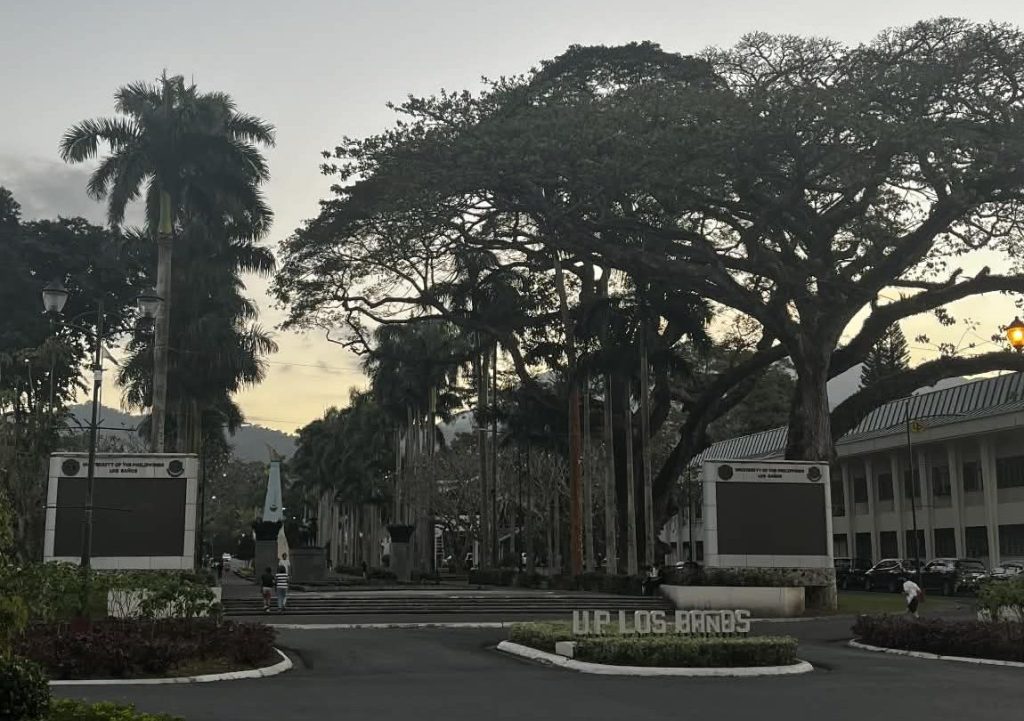
Some part of me assumed that going back to the University of the Philippines Los Baños would feel neutral. Not meaningful, not emotional, just another place I used to exist in. I told myself I was only there to see a friend and maybe shoot a few clips for YouTube while I was on campus. I wasn’t returning to rethink my life or to romanticize unfinished things. I just wanted to walk through something familiar and leave without it rearranging anything inside me.
But the moment I stepped into UPLB, I felt off in a way that didn’t make sense at first. Nothing catastrophic happened. The buildings were still standing, the trees still framed the paths the way I remembered, but the small details were different. New cafes had replaced the old ones. There were faces I didn’t recognize filling the same spaces where my own routines used to exist. And before I could even fully register those changes, I caught myself thinking about staying. About re-enrolling. About finishing what I had started years ago.
The thought didn’t feel sentimental. It felt logistical. It felt like reaching for a container with edges and deadlines, something that had a measurable end. And the fact that structure felt comforting to me in that moment unsettled me more than nostalgia ever could have, because it forced me to confront how unstructured my present life actually feels.
I Didn’t Leave Because I Failed
Before anything else, I need to say this clearly, because even I sometimes forget it when the insecurity creeps in.
When I stopped studying at the University of the Philippines Los Baños, I was not failing. I was a BA Communication Arts student majoring in Speech Communication, and I was in Magna Cum Laude standing. I had worked for that in a way that felt personal. In UP, being good is not enough; you have to be consistent, and consistency costs energy. I remember the exhaustion of chasing precision in my papers, the way I would push concepts past what was required because I liked thinking too much. I liked overreaching. I liked building arguments that were almost too ambitious for the page. Some professors appreciated it. Others thought I was scattered or trying too hard. They weren’t entirely wrong. I was trying too hard. I wanted to see how far I could stretch my own brain.
Most of the time, I didn’t even study traditionally for exams. I was usually working on papers, or ghostwriting articles for small fees because I needed the money. The exams felt secondary to the act of building something longer, more layered, more mine. I liked that part — wrestling with ideas, rearranging them, cutting and rebuilding sentences until they felt sharper. I miss that. I miss being forced to think at that scale, under pressure, with deadlines that weren’t self-imposed.
UPLB wasn’t just academics, though. It was an era of experimentation in every direction. I colored my hair more times than I can count, as if changing it would help me land on a version of myself that felt definitive. I walked around campus for hours — sometimes two hours a day, just circling familiar routes, thinking, overthinking, replaying conversations, rehearsing futures that hadn’t happened yet. There were nights I slept like a pig, fully collapsed after a week of stretching myself too thin. And then there were days I had the flu, body heavy and aching, but I still forced myself to finish a paper because I liked it too much to let it sit incomplete.
I attended parties, not because I was the center of them, but because I wanted to feel like I was inside the story. I kissed people. I fell in love — or in versions of love that felt complete and urgent in the moment — more than once. I floated socially. I wasn’t the most popular, but I wasn’t invisible either. I could move between groups. I could sit with different circles and adjust myself accordingly. I was constantly aware of how I was being perceived, constantly recalibrating, trying to balance being curious and being acceptable.
Underneath all of that was a quiet pressure I didn’t talk about much: if I don’t figure this out, if I don’t build something solid out of all this curiosity and ambition, I will disappoint myself. Not my professors. Not my friends. Myself.
Then the pandemic hit, and the abstraction of grades and ideas collapsed under the reality of survival.
Becoming the breadwinner wasn’t gradual. It wasn’t romantic. It was immediate and total. I became fully financially responsible for my family. Not assisting. Not helping out. Fully responsible. Bills arrived whether I was in Magna Cum Laude standing or not. Finishing my degree became something I wanted, but couldn’t prioritize over keeping things afloat. Stopping wasn’t a failure. It was a sacrifice, and I knew it as I made it. That awareness didn’t make it easier. It just made it heavier.
When I stepped away from UPLB, I told myself it was temporary. I told myself I would return and finish what I had started. I didn’t interrogate that thought too deeply. It was comforting enough to leave unexamined.
I didn’t realize I was carrying that possibility like a quiet insurance policy.
The First Time I Came Back, I Thought It Was Just Grief
When I returned to the University of the Philippines Los Baños in 2024, I let myself believe that the discomfort was simply because everything was still fresh. I had stopped studying in 2023. The shift from being a BA Communication Arts student majoring in Speech Communication, in Magna Cum Laude standing, to being fully financially responsible for my family hadn’t had time to settle into something neutral. Of course it would hurt to step back into a place that once structured my days. Of course it would feel strange to move through familiar paths without a student ID in my pocket. I labeled it grief and allowed that explanation to be sufficient.
Coming back again in 2026 removed that comfort.
This time, enough distance had passed that I assumed the campus would feel archival — like something I used to inhabit but no longer emotionally depended on. Instead, it felt active.
My friend and I bought dinner from McDonald’s and walked to Oblation Park. It was nighttime. The air was cooler, quieter in some ways but still alive. We sat on one of the benches near the Oblation statue, unwrapping food, talking about life in that unstructured way conversations happen when you’re not trying to impress each other. Students passed by in the dark, moving in pairs or small groups. There were runners looping around the park, steady, repetitive, almost mechanical in their pacing. Even a week after February Fair had ended, some booths were still set up — structures lingering as if the celebration hadn’t fully dismantled itself yet.
The campus felt in motion.
We noticed something at the same time: the students looked more stressed than I remembered from when I first entered in 2018. More mature, less tentative. There was a tightness in the way they carried themselves. My friend pointed it out too, even though he’s not a UP student, just someone local to Los Baños who has watched batches come and go. It didn’t feel like nostalgia comparing generations. It felt observational. Something in the atmosphere was heavier.
Sitting there at night, in front of the Oblation — arms extended, body offered — I couldn’t avoid the parallel, even if I didn’t want to romanticize it. Sacrifice had rearranged my life too. I had stepped out of a container with clear academic milestones and into something undefined because survival demanded it. That choice was not symbolic at the time. It was practical. Immediate. Necessary.
But being back in that space, no longer enrolled, no longer structurally inside it, I felt the absence of placement more than anything else.
I wasn’t jealous of the students passing by. I wasn’t resentful. I was aware. Aware that I no longer belonged to that rhythm. Aware that whatever version of me once walked those paths daily had been replaced by someone carrying different responsibilities, different timelines, different pressures.
The first time I returned, I thought the ache was just the residue of something interrupted too soon.
The second time made me confront a quieter truth: I was not in between semesters. I was not on pause. I had exited the system, and the system had continued without leaving a space open for me.
Older Than Them, Younger Than Them
Sitting there at night, watching students move through Oblation Park, I felt older than them in a way that had nothing to do with age. It was the weight of responsibility, the kind that compresses your options without asking whether you feel ready. I had already stepped outside the academic system and into something far less predictable. I had already traded semesters and syllabi for bills and financial calculations. There is a certain heaviness that comes from knowing that your time is no longer measured in academic units but in obligations.
And yet, at the same time, I felt younger.
There was something about the students passing by — stressed, yes, but structurally contained — that made me aware of how undefined my own life currently feels. They were exhausted within a framework that made sense. Their stress belonged to something with milestones and visible endpoints. Mine doesn’t. Mine stretches forward without a syllabus, without a fixed graduation date, without the reassurance that if I endure long enough, there will be a ceremony marking the end.
That contradiction unsettled me more than the campus changes did. I was older in responsibility but younger in structure. I had exited a container that once told me who I was and where I was headed, and now I exist in a space where identity is self-constructed and constantly under negotiation.
What I felt that night wasn’t jealousy and it wasn’t regret. It was the absence of placement. I am no longer anchored to that system, and I am not yet anchored to the life I am building outside of it. Being in between sounds neutral when written down, but in practice it feels like standing without a clear outline, aware that the ground beneath you no longer belongs to you while the ground ahead hasn’t fully formed.
Trying to Ground Myself
After sitting at Oblation Park and talking about life in front of a monument that quietly symbolizes offering, I went back to my Airbnb with a restlessness I didn’t want to examine too closely. The campus had stirred something old in me, something about placement and unfinished trajectories, and I could feel my mind beginning to loop. I didn’t want to sit in that loop alone.
Later that night, I met up with another friend. We drank inside the room first, not in a chaotic way but in that familiar, slow-burning way where conversation becomes softer and more honest as the alcohol lowers the volume of whatever you’ve been overthinking all day. At some point, physical closeness happened. It wasn’t dramatic or emotionally loaded. It felt less like desire and more like anchoring, like choosing gravity over abstraction. For a while, I wasn’t analyzing my life or comparing timelines. I was simply inside sensation.
We eventually moved to a bar, letting noise and movement replace the introspection that had been building since the afternoon. When we came back to the Airbnb, there were more drinks. Another person joined us. The room felt temporarily full — voices overlapping, bodies occupying space, distraction doing its job. And then, gradually, they left. The door closed. The air thinned.
When the room emptied, the feeling that settled in wasn’t dramatic, but it was sharp enough to notice. I felt alone in a way that was heavier than solitude. There was a flicker of abandonment in it, not because anyone had done anything wrong, but because the noise that had been buffering the day was gone. I was back with myself, in a city that used to organize my life, in a room that belonged to no one permanently.
The next morning stretched past where I expected it to. Another encounter happened, not in chaos but in the strange elasticity of late morning when time feels detached from structure. It ended quietly around ten. Afterward, I ordered food from Janges — a place I used to eat at when I was still a student. That choice wasn’t random. It felt almost automatic, like muscle memory guiding appetite. I ordered more than I needed and ate most of it, as if familiarity in taste could compensate for the unfamiliarity of who I am now in that space.
Then I slept. Deeply. Not elegantly. I didn’t wake up until 12:30 the following day. It wasn’t indulgence. It felt like my body shutting down after holding too many threads at once — past and present, responsibility and regression, structure and drift.
If I describe those two days plainly, they sound excessive. If I describe them honestly, they felt like attempts at regulation. Drinking dulled the internal scanning. Physical closeness anchored me temporarily in the present. Familiar food reconnected me to a version of myself that once felt placed. Sleep gave my nervous system a chance to reset.
But when I woke up fully and the haze wore off, the deeper misalignment remained. Nothing about the encounters felt wrong. There was no shame attached to them. What lingered was something else entirely — the awareness that grounding the body does not automatically resolve the quiet fracture underneath.
The Illusion Wasn’t Romantic. It Was Practical.
The absence of a dramatic realization that morning is what unsettled me most. If there had been a clean thought — something decisive or even self-critical — I could have wrestled with it. I could have argued with it. But what remained after the haze lifted wasn’t a sentence. It was an understanding without language.
For years after I stopped studying in 2023, I carried a quiet assumption that I would return to the University of the Philippines Los Baños once things stabilized. I never articulated it fully. I never made concrete plans. But it existed in the background as a structural safety net. I had stepped away because I had to become fully financially responsible for my family, not because I failed, not because I lost capacity. The narrative I held onto was simple: this is temporary, this is sacrifice, and once survival becomes manageable, I can finish what I started.
What I didn’t admit to myself is that even when I stopped in 2023, I already sensed that the current had shifted. Responsibility has a way of rearranging your trajectory in quiet but permanent ways. You tell yourself you will return because it softens the immediate loss, but somewhere underneath that comfort is the awareness that life rarely restores you to the exact point where you paused.
Sitting at Oblation Park in 2026, watching students move through a structure that no longer included me, made that background assumption harder to maintain. The campus did not feel like a chapter on hold. It felt like a system that had absorbed my absence and recalibrated without leaving a gap.
The illusion I was carrying wasn’t sentimental. It wasn’t about romance or nostalgia. It was about practicality. It was about the comfort of believing that if my current path collapsed, I could re-enter a familiar container and resume a measurable trajectory. That belief made the uncertainty of building a life outside institutional structure feel less absolute.
But the visit exposed something I couldn’t ignore: I am no longer paused in that system. I am no longer temporarily outside of it. I am structurally elsewhere.
And recognizing that did not produce panic. It produced a heavier kind of awareness — the kind that settles into your chest without theatrics and forces you to confront the fact that there may not be a clean reset waiting for you.
When the Safety Net Disappears
The pressure didn’t arrive as panic. It didn’t even arrive as a clear thought. It settled more slowly than that, the way humidity settles into skin without you noticing until you realize your clothes feel heavier.
For years after I stopped studying in 2023, the idea that I could eventually return to the University of the Philippines Los Baños functioned as a quiet structural reassurance. I never announced it. I never built timelines around it. But it existed in the background as a possibility. If the creative path stalled. If finances became unsustainable. If everything I was trying to build turned out to be thinner than I thought — there was still a container I had once belonged to, one that had measurable progression and visible completion. I could finish what I started. I could convert sacrifice into closure.
That background possibility made uncertainty more tolerable.
When that possibility dissolved during this visit, it didn’t shatter anything dramatically. It just removed that invisible brace I didn’t realize I was leaning on. And without it, the creative path stopped feeling like an evolving direction and started feeling like a single thread stretched tight between obligation and identity.
The thing about building something self-directed is that there are no institutional checkpoints to tell you whether you’re on track. No semester grades. No honors standings. No transcript to point to when doubt creeps in. There is only output and silence. You publish. You produce. You plan. You revise. And then you wait. The return, if it comes, does not announce itself cleanly. It arrives slowly, unevenly, sometimes not at all.
When you add financial responsibility to that equation — when you know people depend on your stability — the abstract idea of “following your passion” becomes something much less romantic. It becomes a daily negotiation between belief and practicality. It becomes the quiet question of how long you can sustain faith in a direction that has not yet yielded structural proof.
Sitting in Los Baños, realizing that I no longer belonged to the university and no longer carried a realistic plan to return, I could feel that negotiation tighten. The creative path was no longer a brave alternative. It was the only path I had continued walking. And that recognition did not inspire me. It pressured me.
Pressure, in this context, isn’t loud. It doesn’t scream that you chose wrong. It whispers something more insidious: there is no reset button. There is no semester you can re-enroll in to recover lost momentum. There is only continuation, and continuation requires stamina.
What unsettled me wasn’t doubt about whether I love what I create. I do. What unsettled me was the awareness that love does not guarantee stability, and stability is no longer optional in my life.
The safety net was never dramatic. It was practical. And when practicality dissolves, you are left confronting the full weight of your decisions without insulation.
The Fear Didn’t Disappear. It Grew Up With Me.
When I first stepped into the University of the Philippines Los Baños at seventeen, fear already lived in me in a quiet, ordinary way. It wasn’t the kind of fear that looks dramatic from the outside. It was more like a constant background calibration: the sense that I had to become someone real before life decided I wasn’t worth the space I took up. I didn’t always have language for it back then, so it leaked out through behavior, through how I moved through rooms, through how I attached too quickly to attention and then pretended I didn’t care, through the way I watched myself from a distance as if I were both the actor and the audience at the same time.
There were social seasons where I felt ugly in the bluntest possible way, and that ugliness wasn’t just about appearance. It turned into a broader feeling of being unchosen, slightly outside of whatever invisible system decides who gets warmth and ease and belonging without having to earn it. In response, I built other kinds of proof. I became more curious than was comfortable. I colored my hair more times than necessary, as if altering something visible could quiet something internal. I walked around campus for hours, sometimes two hours a day, repeating routes until repetition started to feel like a form of control. I attended parties. I kissed people. I fell in love in the intense, urgent way you do when you’re young and still confusing desire, attachment, and meaning. I joined extracurriculars and made acquaintances across circles. I floated socially, never fully central, not always invisible either, and I learned how to move between groups without letting anyone see how much I was still scanning for where I belonged.
Academics became the cleanest version of proof I could hold onto, because they had structure and numbers and an official language attached to them. Being in Magna Cum Laude standing mattered to me because I worked my ass off for it, and because the work felt like evidence that I wasn’t just drifting through my own life. I wasn’t always the student who studied for exams in a traditional way, either. A lot of my energy went into papers, into building concepts, into pushing ideas past what was required because I liked challenging my brain and I liked going over the top even when professors found it scattered, too ambitious, too much. There were days I pushed through the flu because I needed to finish something I genuinely liked doing. I ghostwrote articles for small fees because I needed money and because life was already teaching me that effort has to translate into something practical, even if the returns are small.
Then 2023 happened, and the fear got its adult job.
When I stopped studying, I didn’t stop because I failed. I stopped because I became fully financially responsible for my family. The pandemic and its aftershocks didn’t care about my standing or my trajectory. Bills arrived with the same certainty that semesters used to. The sacrifice was conscious. I knew what I was giving up. I also sensed, even then, that life was already pulling me onto a different track. Not because I wanted a different life, but because responsibility had become non-negotiable. That shift didn’t erase the fear I carried at seventeen. It reconfigured it.
Now I’m twenty-five, and the fear doesn’t revolve around whether I can do the work. It revolves around whether the work can hold me.
I have an actual job. I work to survive, and I work because I have to. It keeps the lights on. It keeps the floor from collapsing. It is practical, it is real, it is immediate, and it is not the life I am trying to build as my final shape. The creative path, the blog and YouTube and whatever else I’m trying to grow into, is the thing I’m building alongside that survival work. It’s the part of my life that feels like mine. It’s also the part that takes time, demands consistency, and has no guaranteed return schedule. Some days it feels like faith. Some days it feels like pressure disguised as faith.
So the fear I had at seventeen didn’t disappear. It matured into something more specific and more expensive.
At seventeen, disappointing myself meant not becoming someone substantial, not turning potential into something visible, not being chosen, not being placed, not finishing what I started. At twenty-five, disappointing myself means something sharper: it means working hard for years, carrying responsibility, and still failing to build a life that feels structurally mine. It means surviving, but never arriving. It means the creative work staying a “someday” while the job becomes the permanent center by default. It means looking back and realizing that the self who endured all of this didn’t get the stability and meaning he was promised for his effort.
That’s why going back to UPLB hits the way it does. A campus is not just buildings. It’s a container that once gave me placement, a label, a timeline, and the illusion of completion if I just kept going long enough. Returning there doesn’t simply activate nostalgia. It activates the unfinished part of my nervous system that still associates structure with safety and completion with worth. It activates the old hyper-awareness, the scanning, the subtle shame, the fear of being the person who tries hard and still doesn’t finish.
The fear isn’t childish. It’s continuous. It grew up with me, attached itself to adult responsibilities, and learned how to wear a calm face while doing the same thing it always did: asking whether all of this effort will finally become something solid.
After the Visit, My Nervous System Shut Down
What surprised me wasn’t the night itself. It wasn’t the drinking, the intimacy, or the long sleep. It was what followed in the days after I returned home. A kind of internal contraction began to take shape. I didn’t want to meet anyone. I didn’t want to explain anything. I didn’t want to perform stability. I wanted quiet in a way that felt almost protective.
It wasn’t shame. It wasn’t regret. Nothing dramatic had happened. But something in me had been stirred and I could feel that my system was asking for containment. Going back to UPLB had reopened layers that I had been managing functionally — the unfinished degree, the sacrifice, the structural ambiguity of my current life — and instead of producing clarity, it produced destabilization.
Destabilization is subtle when you are high-functioning. You still go to work. You still eat properly. You still sleep when you can. You still maintain routines. On the surface, nothing collapses. But internally, your baseline shifts. The margin of emotional bandwidth narrows. Conversations feel heavier than they should. Social interaction feels like labor instead of exchange.
What I felt after the trip was not a dramatic existential spiral. It was a recalibration. My nervous system had been pulled between past identity and present responsibility, between a container I once belonged to and a life I am still constructing. That tension takes energy. And when the tension releases, even slightly, the body often asks for isolation.
The desire to not socialize for a month isn’t antisocial. It feels more like repair. When you realize that life does not pause to give you time to catch up, that the carousel keeps turning whether you are ready or not, there is a moment where you either try to outrun it or you step off temporarily to regain balance.
I think I stepped off.
The Carousel Never Stops
In Season 11 of Grey’s Anatomy, after Derek dies, there is a stretch of episodes that unsettled me more than the death itself. Meredith doesn’t collapse publicly. She doesn’t stage a dramatic unraveling inside the hospital corridors. She leaves. Quietly. She removes herself because staying in the center of that loss feels unbearable. And yet Grey Sloan Memorial continues functioning with clinical precision. Surgeries are performed. Interns complain. Attendings argue. The fluorescent lights remain indifferent. The system does not bend around her grief.
That detail — not the tragedy, but the continuation — stayed with me.
During the pandemic, when everything in my own life began shifting from abstract stress to material responsibility, that show became an anchor in a way I didn’t fully understand at the time. It wasn’t escapism. It was familiarity. Every episode reinforced the same uncomfortable truth: devastation and routine can coexist. You can lose something central and still be required to operate. The hospital never pauses because a surgeon is grieving. The carousel keeps turning.
What made that arc special to me wasn’t the romance of resilience. It was the cruelty of indifference. The world inside that show did not conspire against Meredith. It simply did not adjust. Her internal collapse did not register as a reason for the structure to soften.
That is the texture of the last few years of my life.
When I became fully financially responsible for my family, nothing slowed down to accommodate that shift. The bills did not arrive more gently. The expectations did not recalibrate. When I stepped away from a structured academic path in 2023, the world did not hold a placeholder for me. It did not freeze that version of my identity in preservation. It continued rotating new students, new stress, new life through the same spaces. When I built a survival job to sustain stability, that job did not reduce the parallel demand I placed on myself to build something meaningful beyond survival.
Life did not attack me. It did not single me out.
It simply continued.
And that continuation carries a specific kind of psychological weight. There is something destabilizing about realizing that your internal transitions do not interrupt external motion. You can feel between identities, between containers, between versions of yourself, and the mechanism does not register your disorientation as a reason to slow.
The carousel metaphor works because it is mechanical. It does not ask how you feel before it rotates. It does not offer you a seat adjustment when you are tired. It turns, evenly, predictably, without malice and without mercy.
Watching Meredith stand in that season — removed from her former life, carrying grief privately while the hospital ran as usual — felt like recognition. Not because my circumstances mirror hers in scale, but because the structure of the experience is familiar. You process loss in motion. You metabolize identity shifts while maintaining function. You leave something behind, and the world does not memorialize your departure.
That indifference is not villainous. It is structural.
But structural indifference can feel cruel when you are exhausted from adapting without pause.
The exhaustion I carry is not dramatic despair. It is the cumulative weight of having to keep recalibrating while nothing outside me slows down. It is the fatigue of maintaining survival, building something new, and processing who I am becoming — all at once, all in real time.
The carousel does not stop.
And the hardest part is not that it keeps turning.
It’s that you are expected to keep your balance while it does.
Time Is Not Neutral
What stayed with me from that season was not the spectacle of loss. It was the quiet restructuring of identity that followed it. Meredith doesn’t just grieve Derek; she carries his child in isolation. She gives birth away from the people who knew her before. When she returns, she isn’t the same woman who left. She isn’t restored to a previous version of herself. She occupies the same physical spaces, but the coordinates of who she is have shifted. The container remains, but the center has moved.
That subtle shift feels closer to my experience than any grand metaphor about continuity.
When I stopped studying in 2023, I didn’t just pause an academic trajectory. I altered the axis of my life. I became fully financially responsible. I entered survival mode in a way that redefined priority, time, and identity. Returning to a campus years later does not reinsert me into the same narrative. I don’t stand there as a student on leave. I stand there as someone who reorganized himself under pressure and never fully rebuilt the surrounding architecture.
At seventeen, I believed that effort would eventually crystallize into recognition. I believed that if I endured the semesters, the proof would be official. That belief wasn’t naive; it was scaffolded by the system I was inside. Now I exist outside that scaffolding. I work to sustain survival. I build creatively to shape something that feels aligned. But there is no registrar’s office stamping the years as valid progression. There is no ceremony marking the midpoint.
Meredith returns to the hospital altered but still within a defined institution. I operate altered without one.
That difference matters.
Time inside structure feels directional. Time outside structure feels interpretive. The longer it stretches without visible consolidation, the more it demands that you decide what it means. You cannot outsource that interpretation to an institution anymore. You cannot wait for an external marker to validate the transition.
And that is where the exhaustion thickens.
It is not that nothing is happening. It is that everything is happening without a clear frame.
The Fear of Stopping, The Trauma of Continuing
If I project five years forward, what unsettles me most is not the image of myself still trying. It is the image of myself having stopped. Stopped building. Stopped writing. Stopped reaching for something that feels structurally mine. The idea of resigning fully to survival mode, of allowing the job to become the only architecture in my life, feels heavier than the risk of endurance.
That tells me something uncomfortable.
It tells me that the creative path is not optional in the way I sometimes pretend it is. It is not a hobby. It is not decorative. It is tied to identity in a way that feels existential. Stopping would not just mean abandoning a project. It would mean amputating a part of myself that has been consistent since I was a student pushing concepts too far in papers because I liked the stretch.
And yet continuing without visible return carries its own psychological cost.
There is a kind of low-grade trauma in sustained effort without reinforcement. Not dramatic trauma. Not catastrophic. But cumulative. The nervous system adapts to prolonged uncertainty differently than it adapts to acute stress. Acute stress spikes and resolves. Prolonged uncertainty hums. It requires you to keep believing without clear evidence that belief is structurally sound.
The longer that hum continues, the more it infiltrates baseline resilience. You start questioning not just outcomes, but your threshold for endurance. You begin to measure how much of yourself you can keep investing before the investment begins to feel like depletion.
This is the double bind.
If I stop trying, I risk becoming someone who chose stability over becoming. That future feels suffocating. If I keep trying without visible consolidation, I risk years of sustained ambiguity that slowly erodes confidence.
The carousel metaphor shifts here. It’s no longer just about motion continuing without pause. It’s about being required to choose whether to remain on it voluntarily. No one is forcing me to build creatively. I choose it. And because I choose it, the weight of its uncertainty becomes mine to metabolize.
That is where the destabilization from the UPLB visit connects back in. Standing in a place that once offered a linear trajectory reminded me that I am no longer on a track with automatic consolidation. I am on a track that requires self-validation in the absence of institutional reinforcement. That is a harder psychological terrain.
The fear of stopping reveals how essential this path feels.
The trauma of continuing without visible return reveals how fragile endurance can become.
Both truths exist at the same time.
The Instinct to Pause
When I think about destabilization, I don’t imagine burning everything down. I don’t imagine making dramatic declarations or abandoning the path entirely. What surfaces instead is something quieter. I want to step back. Not permanently. Not symbolically. Just enough to exist without performance. Enough to feel my own edges again.
There is a difference between quitting and pausing, but when you are used to equating endurance with worth, even pausing can feel like betrayal. For years, I have associated forward motion with survival. Work sustains income. Creative output sustains identity. Movement has been my default coping mechanism. Even when the returns are slow, the act of continuing has functioned as proof that I am still in control of direction.
Wanting to pause interrupts that logic.
It exposes how much of my self-concept has been tied to productivity. If I am not advancing something — financially, creatively, structurally — who am I in that moment? Just existing without constructing feels unfamiliar. Almost indulgent. Almost dangerous. As if stillness might unravel the momentum I worked so hard to build.
And yet the body doesn’t lie.
After returning from Los Baños, after the layered encounters and the long sleep and the quiet realization that there is no external container waiting to stabilize me, what I wanted most was not reinvention. It was containment. I didn’t want to socialize. I didn’t want to narrate my growth. I didn’t want to compare trajectories. I wanted silence long enough for my nervous system to recalibrate.
Pausing, in this sense, is not retreat. It is integration.
If time outside a container feels exposed, then creating temporary stillness becomes a way of building micro-containers for myself. A week. A month. A stretch where I am not proving, not expanding, not stretching toward an outcome. Just existing without translating existence into output.
That instinct does not mean I am losing resilience.
It may mean I am learning how to protect it.
Healing, and the Temptation to Disappear
When I say I want to pause, I don’t mean collapse. I don’t mean abandonment. I mean recovery. I mean giving my nervous system time to settle after being pulled between past identity and present responsibility. I mean letting the destabilization breathe without immediately converting it into productivity.
But I would be lying if I said that healing is the only impulse there.
There is also the temptation to disappear for a while.
Not permanently. Not in a self-destructive way. Just enough to stop being observed. Enough to stop narrating my own growth. Enough to not measure myself against peers, timelines, expectations, and imagined outcomes. Hiding carries a strange softness when you’ve spent years performing resilience.
If I had the luxury to retreat without consequence, I would probably take it. That admission feels almost indulgent because I know that responsibility does not disappear when I want it to. The job remains. The bills remain. The creative work remains waiting for continuity. The carousel does not pause simply because I want quiet.
That is where the friction lives.
Healing requires space. Hiding requires distance. Responsibility requires presence.
Balancing those three is not elegant.
The instinct to pause does not mean I am giving up on the creative path. If anything, it proves how central it is. You do not feel this destabilized about something trivial. You do not fear stopping something that does not matter to you. The intensity of the reaction reveals attachment. The desire to hide reveals fatigue.
And fatigue is not failure.
Fatigue is the body asking for recalibration before it continues carrying weight.
What unsettled me about returning to that campus was not that I want to go back. It was that it exposed how long I have been operating without a defined container and how little space I have given myself to process that shift. I have been surviving. I have been building. I have been enduring. But endurance without deliberate recovery slowly erodes baseline resilience.
Wanting to hide, in that context, is not regression. It is a signal that the system has been stretched thin.
I Don’t Want to Advance. I Want to Be.
Underneath the fear of stopping and the trauma of continuing, underneath the structural absence of containers and the accumulated weight of time, there is something much simpler.
I am tired of existing primarily as function.
For years, my identity has been anchored to responsibility. When I stopped studying in 2023, I became fully financially responsible. That reoriented everything. My value became measurable in survival terms. Could I sustain income? Could I keep things stable? Could I absorb pressure without collapsing? Even the creative path, the thing that feels most aligned with who I am, has slowly been tied to output, consistency, discipline, visibility.
Function layered on top of function.
Worker. Provider. Builder. Producer.
Somewhere inside that layering, being has become conditional. I allow myself to rest only if something has been completed. I allow myself to feel worthy only if effort has been exerted. I allow myself to pause only if I can justify it as strategic recovery.
“To be” is radical in that context.
To be without advancing.
To be without proving.
To be without narrating the next move.
That desire surfaced after returning from Los Baños not because the campus triggered nostalgia, but because it exposed how long I have been operating without granting myself neutral existence. Sitting in front of the Oblation statue at night, watching runners move in steady loops, I wasn’t yearning for academic reinstatement. I was noticing how much of my life has been motion without stillness.
The carousel metaphor feels cruel not because it turns, but because I have been turning with it without asking whether I ever stepped off to simply exist without a role.
The instinct to pause is not laziness. It is the body reclaiming space.
If I strip away fear, strategy, and outcome, what remains is not ambition. It is presence. I want to exist without translating existence into productivity.
That doesn’t negate responsibility. It doesn’t negate the job. It doesn’t negate the creative path. It simply acknowledges that being is not the same as building, and I have been building for so long that I forgot being was allowed without preconditions.
To Be
What I keep circling back to is not ambition, not achievement, not even stability. It’s the fact that I have been living in a clenched state for years. The clenching began quietly when responsibility shifted in 2023. It tightened when survival became primary. It intensified as I tried to build something creative in parallel, determined not to let the part of me that loves stretching ideas dissolve under practicality. Every year that passed without structural consolidation made the grip firmer. Every month of sustaining income while investing in something slower made endurance feel like proof of worth.
Returning to Los Baños didn’t create that tension. It revealed it.
There’s a reason Season 11 of Grey’s Anatomy has stayed lodged in my nervous system. It wasn’t just about Derek’s death. It was about what Meredith does afterward. She disappears, yes. She carries her pregnancy alone. She gives birth to Ellis without the life she imagined beside her. But she does not remain in disappearance. When she returns to Seattle, she does not resume the exact coordinates of her former identity. She rebuilds inside the same hospital, but she inhabits it differently. She allows grief to alter her. She reclaims surgery not as distraction, but as mastery. She raises her children. She eventually wins a Harper Avery. She permits new love without pretending the old one didn’t matter.
Her forward motion is not denial. It is integration.
That distinction matters to me.
I don’t want to erase the seventeen-year-old who believed completion would equal arrival. I don’t want to erase the student who walked campus for hours overthinking identity and ambition. I don’t want to erase the version of myself who stopped studying in 2023 because survival required it. Those versions are not mistakes. They are structural shifts.
What I want is to stop bracing against the fact that I no longer have institutional guardrails translating time into narrative for me. I want to stop measuring my life exclusively in terms of consolidation and visible return. I want to stop acting as though endurance alone is the only acceptable posture.
“To be” is not resignation. It is not stepping off the path. It is removing the tension from my shoulders while I walk it.
Meredith did not stop being a surgeon after Derek. She did not surrender her ambition. She did not pretend the hospital had paused for her grief. She simply stopped trying to inhabit the old geometry of her life. She moved forward without demanding that forward feel like the past.
That is the shift I am trying to allow.
The campus continues. The job continues. The creative work continues. The carousel does not slow itself for my processing. But I do not have to live as though every year without visible consolidation is an indictment. I do not have to treat stillness as failure. I do not have to conflate pausing with stopping.
I can build without clenching. I can work without narrating survival as my entire identity. I can let the timeline extend without interpreting every extension as absence.
If the seventeen-year-old feared disappointing himself, and the twenty-five-year-old fears years of effort without consolidation, then perhaps the next version of me learns something quieter: that identity does not collapse simply because it is not externally confirmed on schedule.
The carousel never stops. That part is true.
But neither did Meredith.
And neither will I.
Not in panic. Not in performance. Not in clenched endurance.
Just forward.
If you found this piece insightful, consider supporting my work – every contribution helps fuel more in-depth stories, reflections, and meaningful content. Support here!
