
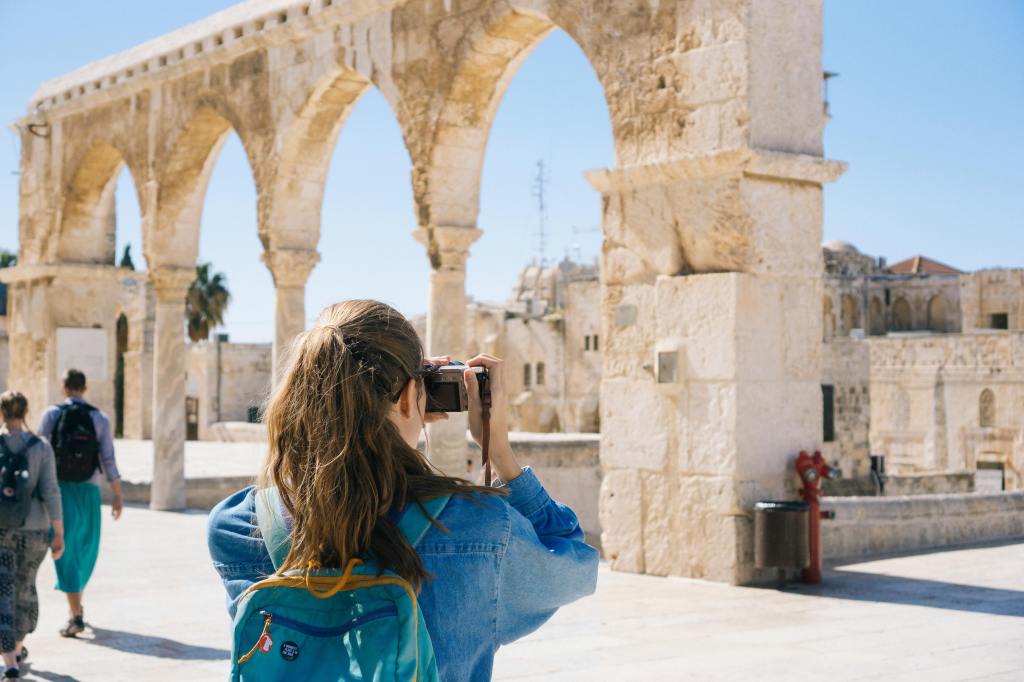
Open your phone and you will see it. Another cinematic reel set to a lo-fi track. A slow-motion drone shot sweeping across a mountain ridge. A caption that says “I needed this.” A carousel of tan skin and bright cocktails. Someone smiling. Someone crying. Someone pretending they are not performing.
Travel content is everywhere. But if you pay attention, most of it says nothing.
What used to be a way of sharing stories has become a template. The emotional arc is predictable. The aesthetics are polished. Even the “authentic” moments feel rehearsed. The vulnerability is calculated just enough to seem real, but not enough to make you uncomfortable. And beneath it all is a quiet, growing emptiness. A feeling that none of this actually matters.
This isn’t just about videos or blogs or reels. It’s about how travel itself has been flattened into content. How the most sacred, strange, or transformative moments are now edited to fit a mood board. And how real storytelling—the kind that stays with you, the kind that challenges you – gets buried under algorithms and trends.
This post was not made for performance. It was written to hold something. To preserve the raw, uncurated weight of what travel can actually offer when you stop trying to make it impressive. If you have ever scrolled through a perfect travel vlog and felt a quiet kind of sadness, you already know what I mean.
Some stories are not meant to trend. Some stories are meant to stay.
- How Travel Became a Performance Instead of a Real Experience
- What Most Travel Creators Overlook When Telling a Story
- How to Create Travel Content That Actually Has Meaning
- The Travel Memory That Would Never Go Viral But Meant Everything
- The Conflict Between Preservation and Performance
- Travel Stories as Legacy, Not Leverage
- Why We Need to Reclaim Travel Stories From the Metrics
How Travel Became a Performance Instead of a Real Experience
It did not happen all at once. Travel was once personal. It was messy. It was private. But somewhere along the way, the shift began. A sunrise shared. A drone shot edited. A caption designed to resonate. What used to be a moment between you and a place became a production, a performance, a post.
The rise of performative travel influencers reshaped everything. Not just how trips are captured, but how they are experienced. Platforms rewarded visual perfection, simplified stories, emotional arcs that resolve neatly within a two-minute video. And we adjusted. We began traveling not to feel, but to be witnessed feeling.
Instead of asking where to go, we started asking what would perform best. Instead of wondering how a place might change us, we wondered how we might appear in it. Authenticity became an aesthetic, not a value. Emotional presence was edited into a beat drop. Even grief was stylized. Even silence had background music.
Travel content became a genre. There was a structure. A rhythm. First, the burnout or the heartbreak. Then the flight. Then the sea. A long walk alone. A voiceover. A visible shift. There is almost always a moment where the creator pauses and tells you how much they needed this trip. The formula is gentle, digestible, satisfying. It also erases complexity.
Because not all travel brings clarity. Sometimes it brings more questions. Sometimes it makes you feel even more disoriented. Sometimes the most important moments are not aesthetic at all. They’re awkward, quiet, strange. A bad meal that makes you cry. A stranger who says something that stays with you. A street you walk down for no reason and think about for years.
But these moments don’t trend. They don’t perform. So they are usually cut, or softened, or turned into metaphors that can be consumed without discomfort.
This is the quiet danger of performative travel content. It flattens reality into a consumable loop. It encourages creators to extract meaning before they’ve lived it. It tells audiences that the story only matters if it fits the rhythm they’ve been trained to expect. And eventually, the person behind the camera begins to split. There is the traveler. And there is the character they play.
The traveler forgets how to move through a place without thinking about the frame. They forget how to sit still without scripting it. They forget how to experience anything without wondering how to package it for someone else’s feed.
This is not about blame. This is about recognition. Many creators feel this tension. They know something has been lost. They know they’re skimming the surface of their own experience because the algorithm does not reward depth. And the pressure to keep up becomes louder than the voice that once told them why they wanted to travel at all.
If you’ve ever stood in a beautiful place and felt strangely disconnected, this may be why. You were there physically, but mentally you were elsewhere. Watching yourself through the imagined eyes of others. Waiting for the best moment. Thinking about the caption.
But real presence doesn’t care about the caption. It does not need music. It does not need proof.
It just asks you to be there. Fully. Without the performance. Without the plan. Without asking how it will look. Only how it will feel.
What Most Travel Creators Overlook When Telling a Story
There is a story underneath the story, and most travel creators never reach it.
Not because they lack the depth to feel it, but because they’ve been trained to prioritize structure over sensation. The pace of digital platforms rewards efficiency. Certainty. Predictability. If your story can’t be summarized, captioned, and queued for upload, it’s considered unshareable. In that system, everything subtle is treated as disposable.
What gets left out are the parts that travel was always supposed to hold. Moments that are unclear. Feelings that are still forming. The quiet before meaning arrives. The trip within the trip.
Authentic travel storytelling requires what most content systems actively discourage: slowness, contradiction, emotional ambiguity. And yet, these are the very qualities that make a journey transformative. It is not the place alone that changes you. It is the reflection. The discomfort. The way your inner world reshapes itself in relation to what you see.
When creators rush to format an experience before it finishes unfolding, they flatten the most important parts. A spiritual realization becomes a voiceover. A raw emotional moment gets edited into a reaction shot. A long stretch of quiet becomes background footage to support a scripted takeaway. In the process, something essential is lost.
This is not simply about aesthetic choices. It is about narrative erosion. When stories are continually molded to fit platform logic, the storyteller begins to lose sight of what is even worth remembering. The pressure to remain visible outweighs the need to remain honest. And slowly, the creator begins to mistake exposure for intimacy, reach for resonance, rhythm for meaning.
We have reached a point where even vulnerability has become a genre. You can now buy presets for authenticity. You can study the beats of reflective storytelling and copy them without ever being present for the actual transformation.
This is the fracture point.
Travel becomes reenactment. Presence becomes performance. And the audience, despite being flooded with content, walks away with nothing that lingers. The work is forgotten as quickly as it is consumed.
What most travel creators overlook is that storytelling is not the act of recording. It is the act of metabolizing. A story is not something you capture. It is something you return to. It asks you to feel first and speak second. It demands patience. It requires reverence for the things you cannot yet explain.
But patience does not trend. Platforms do not reward reverence. And so we are left with beautiful, hollow stories. Empty of tension. Empty of process. Empty of the silence that once made the story worth telling in the first place.
The result is content that looks full, but holds no weight.
How to Create Travel Content That Actually Has Meaning
To create travel content that holds emotional meaning, you have to start with a different internal posture. The common instinct is to document quickly, to translate experience into shareable content before the emotional sediment has time to settle. Platforms encourage this speed. Visibility rewards immediacy. But stories with depth cannot be extracted in real time. They have to be returned to. And in many cases, they must be endured before they can be understood.
Authentic travel storytelling requires a shift from expression to reflection. This means delaying the urge to package a moment before it’s fully processed. It means recognizing that the most meaningful travel experiences are not always dramatic or cinematic. They may be quiet, unresolved, or difficult to name. They may not have a clear emotional arc. They may not even look like travel at all. But this ambiguity is where meaning often lives. And yet it’s the very thing most travel content edits out.
The digital architecture we create within punishes that kind of complexity. Travel creators are not just working within a visual language – they are shaped by algorithmic norms that demand rhythm, relatability, and emotional certainty. When those are missing, even a deeply personal story can feel unusable. As a result, many creators begin to internalize a structure that requires clarity too early. They rush to narrate transformation before it has fully taken place. They script honesty instead of sitting inside it. They confuse aesthetic cohesion with emotional truth.
To create content that actually has meaning, one must tolerate not knowing. You must be willing to let a moment breathe, even if that means it disappears from relevance. The content that lingers is not always the most polished. It is the one that was made slowly, deliberately, with an ethic of care. And that care must extend not just to the audience, but to the self. When a creator begins to feel more like a brand than a person, the distance between the experience and the story becomes impossible to bridge. You are no longer telling the story of what happened. You are telling the story of what you believe will resonate.
This is not a call to abandon structure or intention. It is a call to question which parts of your story you are discarding in order to fit into a system that was never designed for presence. The pressure to keep up (to stay visible, consistent, relevant) will always be louder than the invitation to go inward. But meaning is not something you create while sprinting. It is something you notice when you stop.
The stories that hold weight are rarely the ones that chase attention. They are often quiet, slow, and emotionally unresolved. But their power lies in their restraint. They do not try to manipulate the audience. They trust the story to speak for itself. And most importantly, they trust the creator to know the difference between what is worth sharing and what is worth holding.
Travel content that carries emotional depth is not about scale. It is about presence. It does not exist to entertain or inform. It exists to preserve. To preserve not the place or the activity, but the internal movement that happened because of it. And preservation requires time. It requires stillness. It requires the creator to stop performing long enough to notice what actually changed.
This is the work. Not to create stories that perform well, but to create stories that remember well. Not for the audience, but for the one who lived them.
The Travel Memory That Would Never Go Viral But Meant Everything
The most meaningful travel memories are often the ones that do not photograph well. They do not announce themselves as significant. They are quiet, unscripted, and unmarketable. They unfold in a way that cannot be condensed into a caption or reverse-engineered into a narrative arc. And because of that, they are often discarded – not by the person who lived them, but by the storytelling frameworks they are expected to inhabit.
For me, one of these moments took place during a short trip to Boracay. It was not a dramatic event. There was no revelation. I had just arrived at the resort. The sky was gray, the wind was sharp, and the beach was almost empty. I stepped outside, lit a cigarette, and sat near the edge of the property. The rain had started again, light but insistent. I wasn’t doing anything. I wasn’t thinking anything extraordinary. There was no camera. No music. Just the sound of water and the feeling that, for the first time in a long time, I didn’t need to explain myself to anyone.
That was it. No footage. No audience. No optimization.
This memory has stayed with me more vividly than others. Not because it was extraordinary, but because it was honest. It was not filtered through performance. It was not interrupted by the question of whether I should be recording it. It was a moment of full presence, of quiet completeness, where nothing was missing. These moments rarely register as content because they do not perform. But they mark something internal. They become a reference point. A memory that remains steady even when everything else shifts.
What matters is not the simplicity of the scene, but the way it resists translation. Any attempt to recreate it would fail, because its meaning was not visual. It was spatial. It was temporal. It had to be felt in that exact weather, with that exact exhaustion, at that particular point in my life. These are the kinds of memories that sit just beneath the surface – not showpieces, but anchors. Not content, but proof.
This is what most travel storytelling misses. Not just the event, but the emotional context that gives the event weight. The stillness. The timing. The sense that something passed through you, even if you couldn’t name it. In a world built on views, these moments are algorithmically invisible. But they are artistically and spiritually essential.
What stayed with me from Boracay was not the trip. It was that hour. It was that rain. And it is enough.
The Conflict Between Preservation and Performance
Even if you reject the aesthetics of mainstream travel content, you are not exempt from its influence. It’s possible to create with presence and still find yourself haunted by the shape of performance. This is the conflict at the heart of meaningful travel storytelling today. The moment you begin to create, you are pulled into a structure that prioritizes visibility over depth. And the moment you choose to protect a story, you may feel like you’re abandoning momentum.
It is not enough to say “just be present.” Presence must be defended. And that defense takes place internally, long before a story is shared. Most creators are not fabricating. They are adapting. They are managing the impossible tension of wanting to preserve a moment while knowing that the act of preserving it often alters it.
You walk into a place that stirs something in you – a feeling that is not ready to be named, a softness you rarely allow. But the mechanics arrive instantly. You frame the light. You reach for the camera. You imagine the edit before the moment has even finished unfolding. You are no longer simply experiencing. You are already performing the experience back to yourself. This split is subtle. It is practiced. It is automatic. And that is what makes it so difficult to interrupt.
Travel content encourages you to be both witness and spectacle. You become the traveler, the archivist, the audience, and the product all at once. In this fractured role, your ability to metabolize the experience begins to atrophy. You are aware of the emotional tone of a moment, but not connected to it. You start to package what hasn’t yet been processed. And that is where the story begins to lose integrity.
Preserving a travel memory is not inherently corruptive. But the method and the motivation matter. If you are creating with the subconscious goal of capturing something that will later impress, the experience shifts. Your gaze becomes extractive. You are no longer relating to the place, but interpreting it for someone else. And the moment you place a story under the weight of performance, you often lose the very thing you wanted to hold.
So how do you protect a story from performance without rejecting the act of creation entirely?
First, you must recognize that not every story belongs to the public. Curation is not censorship. It is a form of respect. If a moment still holds emotional ambiguity, if you are still inside the tension it created, it may be too early to share. Not because it lacks polish, but because it is still alive. And living stories resist containment. To flatten them into a finished product too early is a form of self-erasure.
Second, treat time as a collaborator, not a threat. The pressure to share immediately is not a creative instinct. It is a platform-induced anxiety. Meaningful travel content does not require immediacy. It requires memory. Wait to see what returns to you. Wait to see what remains after the trip. The stories that stay often reveal themselves after the excitement has settled.
Third, adopt a creative ethic that privileges personal clarity over audience approval. You can still film, write, photograph – but the question must shift. Not “how will this be received?” but “what am I trying to remember?” When your creative practice becomes an act of memory rather than performance, the result holds weight, even if it never goes public.
Lastly, if you do choose to share, let the structure follow the story – not the other way around. Resist the impulse to retroactively impose a lesson. Allow the ambiguity to remain. Real moments do not always resolve. They do not always teach. Sometimes they simply open something inside you, and your job is to reflect that truth with fidelity.
Presence, in this context, is not an aesthetic. It is a discipline. And that discipline requires vigilance against internalized performance. You must learn to recognize when you are narrating too soon, when you are reducing something for the sake of relatability, when you are translating presence into performance because you’re afraid the rawness won’t be enough.
The irony is that the stories with the most emotional staying power are often the ones least engineered to succeed. They are not designed to perform. They are written, filmed, or recalled to preserve a kind of internal evidence. They become creative artifacts – less about what happened and more about how it changed the person who lived through it.
Preservation asks for intimacy with the self. Performance asks for approval from others. You can create with both in mind, but one will always dominate the other. If you do not decide which one leads, the platform will decide for you.
Travel Stories as Legacy, Not Leverage
If travel is one of the few experiences that still disrupts routine, then the stories we tell about those disruptions deserve more than optimization. They deserve care. They deserve structure. They deserve a reason for existing beyond clicks, reach, or relevance. The question is no longer whether we are allowed to create travel content, but whether we have remembered how to create something that will actually outlast the feed.
This requires a radical shift in framing. Instead of seeing travel stories as opportunities for leverage (something to convert into growth, credibility, or personal branding) we can begin to view them as a form of legacy. Not legacy in the grandiose, immortalized sense, but as a deliberate record of how you were shaped by a moment in time. In this model, the story is not a tool. It is a trace.
Legacy-driven travel storytelling asks you to tell the truth even when it is incomplete. It allows for interiority. It honors what was misunderstood, unresolved, or not ready to be explained. This kind of narrative holds up not because it’s emotionally perfect, but because it’s emotionally honest. The moment is preserved not for consumption, but for continuity – for the future version of you who might need to return to it, and for anyone else who might see themselves reflected in what you chose to remember.
The truth is, most travel content does not age well. It speaks to a moment, not from it. It is tied to a format that goes stale the second the algorithm pivots. But when you tell a story that holds the complexity of place, of change, of presence, it becomes something else entirely. It becomes a container. And that container is not built to perform. It is built to protect.
There is a difference between travel content that aims to be impressive and travel content that is archival. One is crafted for rapid circulation. The other is shaped for stillness. It may live quietly. It may never trend. But it will stay. And staying is its own kind of power.
To write or film or speak about a travel experience with this kind of depth is not about retreating from audience. It is about refusing to reduce what was sacred just to remain visible. The more we do this – the more we allow real travel stories to remain complex, unhurried, reflective – the more we push back against the pressure to make everything digestible. We remind others, and ourselves, that not everything is meant to be optimized. Some things are meant to be kept.
In this light, the travel blog becomes something closer to an archive. Not an archive of where you went, but of who you were while you were there. It becomes evidence. Not of achievement, but of movement. Emotional, spiritual, internal movement. And the act of creating it becomes less about remembering the destination and more about protecting the transformation.
Leverage turns a story into a transaction. Legacy allows it to remain a turning point. You get to decide which one you are making.
Why We Need to Reclaim Travel Stories From the Metrics
It is easy to forget that travel was never meant to be public. It began as departure. As solitude. As a disorienting return to the self. The story came after, if it came at all. And even then, it was told not for recognition, but for reckoning. To understand. To preserve. To say, “This happened, and I am no longer the same.”
We are now in a cultural moment where every experience feels like it must justify itself through content. Where stories are shared before they are even processed. Where presence is harvested into performance, and stillness is seen as wasted potential. But just because a system encourages you to turn your life into leverage does not mean you have to obey it.
Travel storytelling can be reclaimed. It can be slowed down, restructured, and reimagined. You can choose to tell the kind of stories that stay. Stories that resist oversimplification. Stories that hold emotion without needing resolution. Stories that are shaped not by what people expect to see, but by what actually happened.
If you are someone who documents your experiences, the challenge is not to abandon the work. The challenge is to protect the story from becoming hollow. To remember that the point is not to perform transformation, but to tell the truth about how it arrived. Quietly. Imperfectly. In ways no edit could ever fully capture.
The most powerful travel blogs are not the ones that go viral. They are the ones that feel like a conversation with the self you almost forgot to listen to. They do not demand attention. They earn intimacy.
Reclaiming travel stories from the metrics does not mean you reject visibility. It means you redefine value. It means you tell the story anyway, even if it is too quiet to be trending. Even if it is too honest to be digestible. Even if it is only meant for one person, years from now, who might need to see proof that someone else once chose presence over performance.
Some stories are not meant to be content. Some stories are meant to be kept.
If you found this piece insightful, consider supporting my work – every contribution helps fuel more in-depth stories, reflections, and meaningful content. Support here!
